
Article: Balanced vs Single-Ended: Does it Matter?
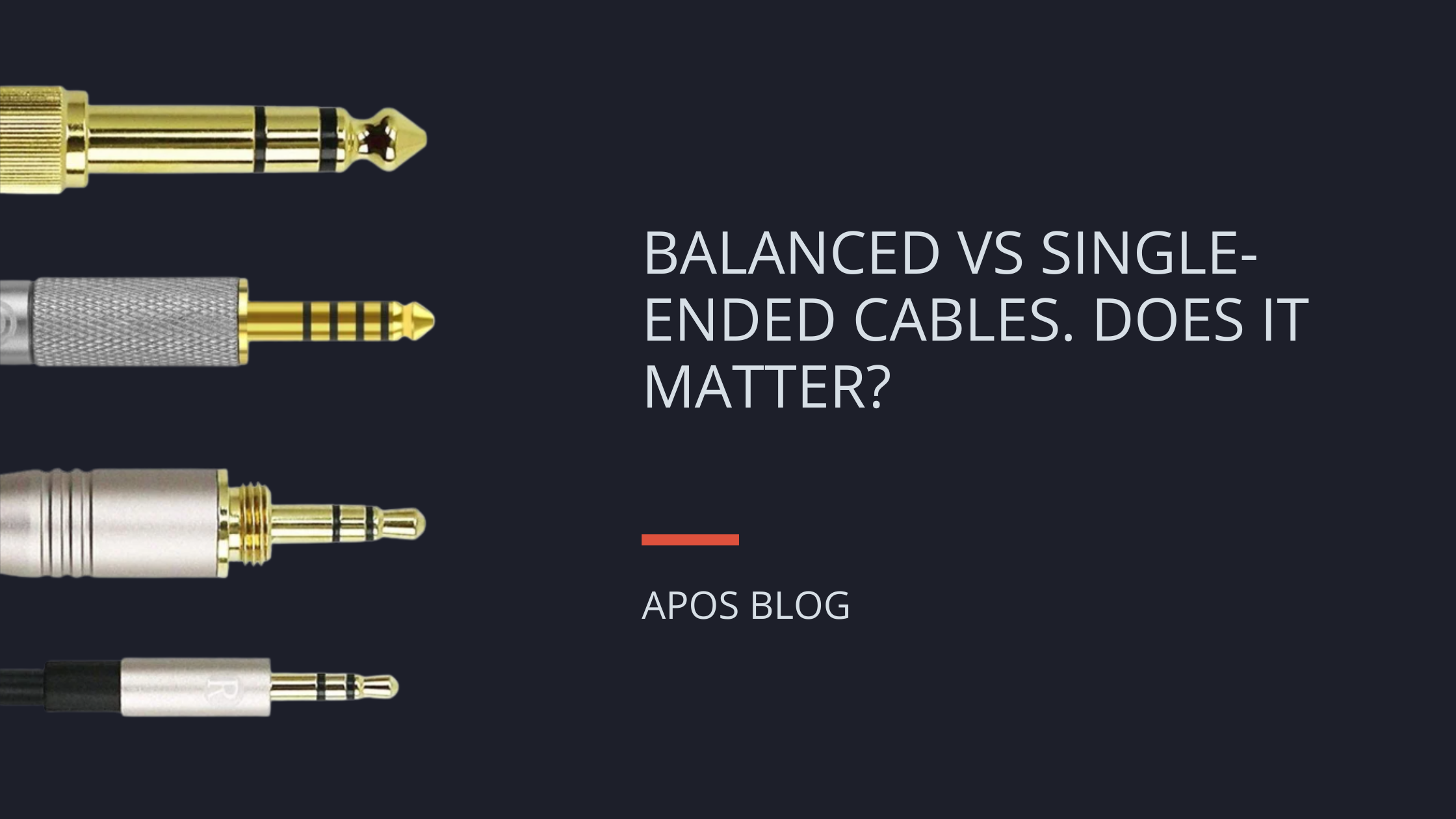
Balanced vs Single-Ended: Does it Matter?
Yes, they do matter, but one type of cable doesn’t inherently sound better; they just work differently to solve specific problems in an audio chain. There’s no clear winner here because each design serves a distinct purpose.
With that said, single-ended cables offer an affordable, effective solution for simple chains, while balanced cables provide the heavy lifting and noise reduction required for production and professional use.
If single-ended designs were inherently "worse," options like the Apos Flow Cables wouldn't exist in a single-ended form factor.
Single-ended Cables
Hands down, single-ended cables and devices win on simplicity. You'll find them in almost every smartphone, laptop, and headphones because they're easier to manufacture and integrate. This straightforward design keeps consumer electronics compact and affordable.
However, single-ended cables act more like antennas compared to balanced ones. Because they only use two conductors (signal and ground) per channel, interference from other sources could hitch a ride directly into your device.
I learned this the hard way when I was working in a production environment, thinking that coiling power and amplifier cables together helps to tidy things up. Congratulations to me, I made an inductor.
Balanced Cables
Balanced cables and devices solve the noise problem by using two signal conductors, plus a ground. Most cables just carry a signal and a ground, but balanced systems add a second signal wire to the mix. The gear sends your audio down both wires simultaneously, flipping the polarity of the second one so they're perfect mirrors.
|
Type |
Conductors |
|
Single-ended |
signal, ground |
|
Balanced |
+signal, –signal, ground |
When outside noise hits the cable, it lands on both wires in the same direction. When that signal reaches the receiver, the hardware flips the inverted wire back to normal. This puts the audio back in sync while flipping the noise out of phase, effectively canceling it out.
Balanced cables also greatly reduce ground loops, which is usually associated with components plugged into different wall outlets.
Balanced Differential
Beyond noise cancellation, balanced connections could also be differential, meaning both signals carry an equal yet opposite version of themselves, (e.g., +2 V and -2 V). The difference between them (2 - (-2 ) = 4) is the resulting voltage. Differential balanced outputs often provide about 6 dB more voltage swing than single-ended outputs.
Vout = Vhot − Vcold
4 V = 2 V - (-2 V)
Note that an amplifier can still offer differential output even with unbalanced input connections (e.g., RCA input to a 4-pin XLR headphone output). This typically provides the necessary headroom for power-hungry planar magnetic headphones such as the HIFIMAN Susvara or to maintain signal integrity over long cable runs in a studio or production environment.
Why not make everything balanced?
Balanced connections, especially balanced differential designs are awesome. However, they are inherently more complex to design, and require at least twice the components or circuitry compared to single-ended designs.
Again, this is the reason why we still use single-ended almost everywhere. They work perfectly under conditions where balanced connections are not required.
|
Feature |
Single-Ended |
Balanced |
|
Typical Connector |
RCA/3.5 mm/6.35 mm |
XLR/4.4 mm/6.35 mm |
|
Noise Rejection |
Low |
High |
|
Voltage/Power |
Standard |
Double if differential |
|
Design |
Simple |
Complex |
|
Cost |
Typically affordable |
Usually at a premium |
Which One Do You Need?
I’ve said this before and I’ll say it again: Choosing between these designs and cables should be about your setup’s requirements as much as the technology itself. If you’re stacking a DAC and an amp, a high-quality single-ended setup could save you money.
However, if you're hearing a persistent hum, using incredibly demanding headphones, or running long cables past other cables or a power source, go balanced or differential.
Don’t take this as a be-all-end-all rule, though. Despite everything, balanced gear is cool. I still run them on my stack because those thick cables look great and offer an absolute guarantee that interference is highly unlikely.
I’m a hypocrite.
