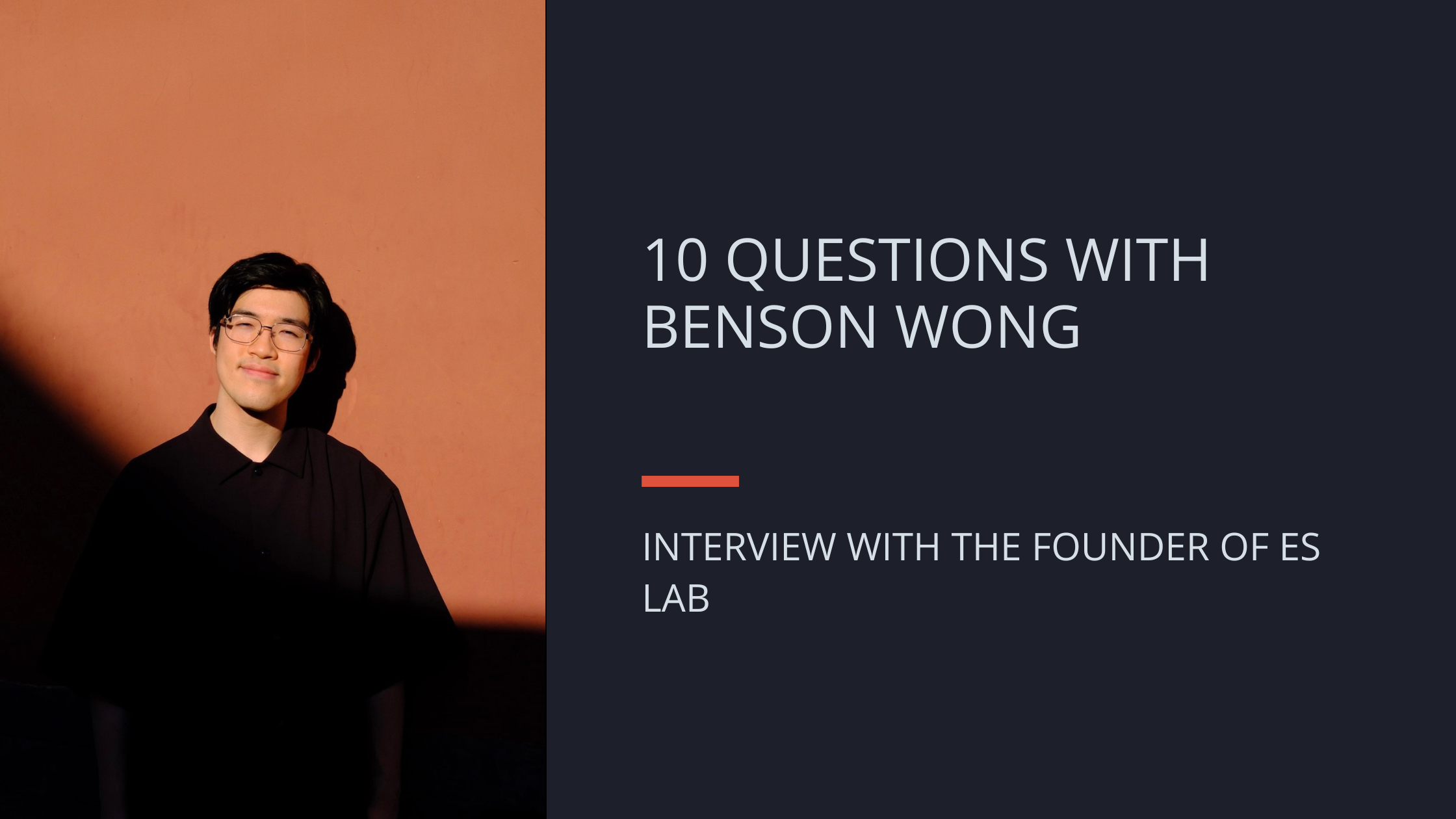
Interview with Benson of ES Lab
Long before ES Lab was known for the ES-1a, ES-2a, or EHT-7, their head engineer, Benson Wong, was diligently keeping electrostatic history alive—repairing discontinued Stax headphones, restoring fragile drivers, and learning firsthand why so many legendary designs didn’t survive the long haul. That work put him face to face with the strengths and failures of classic electrostatics. ES Lab grew out of that tension. In this conversation, Benson talks about chasing the glory of the original Stax Omega, translating vintage electrostatic magic into modern, serviceable designs, why durability matters as much as sound, and how ES Lab approaches making electrostatics more accessible without diluting what makes them special.
Apos: You started ES Lab after years of repairing discontinued electrostatic headphones, especially old Stax models, and offering a dedicated repair service that’s still active today. What was the moment where you decided, “I should build my own headphones,” and what gap did you feel was missing in the electrostatic world?
Benson: Long before I started the ES Lab venture, I was a serious vintage headphone collector, and vintage Stax headphones are my jam. I was amused by how vintage headphones have the ability to interpret music a bit differently, with a resolving and engaging sound. And it always surprises me that such an old headphone could compete with modern offerings face to face in terms of technical qualities.
So, in those years while I was completing my collection, there was inevitably a blank: the original Stax Omega, which had a 10000+ USD price tag. A lot of historical headphone models were only made in small quantities, like only 600 Omega were produced by Stax, making it extremely difficult for us to get a glimpse of what they sounded like.
So, my journey in building headphones began from my curiosity about the original Omega. I learned a lot while repairing my own collection as well as headphones for collectors in the community. Those experiences truly became the foundation for me to build my own model.
Apos: Having opened up and repaired so many classic electrostatic models, what are some recurring weak points you see in vintage headphones—and how did those lessons directly influence the way you design ES-1a, ES-2a, and EX-1a?
Benson: There were many great-sounding headphones made in the past, but only a few of them are still in a flawless working state due to poor design sustainability and part durability. From cracking acrylic driver frames to degraded coatings and diaphragms, I learned while repairing these headphones that it's not enough to build a headphone with great sound—it also needs to be durable and last.
As electrostatic headphones are often falsely perceived as fragile and sensitive, our utmost goal in creating our products is for them to be durable and long-lasting. This way, people will still have the opportunity to appreciate your work in the future, just as I admire vintage headphones today.
Apos: The ES-1a is often described as an homage to the Stax SR-Omega, while the ES-2a is your modern tribute to the “legendary Omega” with an all-new 90mm driver. How do you decide what to faithfully preserve from those classics and where you deliberately choose to diverge in tuning, staging, or technical performance?
Benson: While the original omega is regarded as an all-time legendary model in the history of headphones, it is not perfect. The original omega is somehow a pair of bass light and hard to drive headphones, and the owner needs to invest quite a sum of money on amplification and signal source for the omega to truly shine. But for us, we want to make a model that most people could enjoy, even when they are on a budget setup. For that reason, our es1a, es2a, and ex1a adopted an OFC plate electrode instead of the original mesh electrode seen on the omega. Plate electrodes have the advantage of being easy to drive and excellent bass / soundstage reproduction. This is one of the reasons why most of the feedback we received is positive, with some even claiming that it is better than the omega they have heard.
Apos: With the ES-2a and EX-1a, you’re working with large 90mm and 68mm ultra-thin Mylar diaphragms and extremely thin OFC electrodes. Can you walk us through the main design tradeoffs—size, thickness, tension, electrode geometry—that most strongly shape the sound of your drivers?
Benson: So for an ideal driver in theory, we always wanted the components to have the perfect specifications, like we always wanted a diaphragm as light and thin as possible. While the advancement in technology allows us to achieve further, the factor of stability and subjective listening experience comes into play, and sometimes we need to take a step back. Many headphone makers nowadays chase for thinner diaphragms under 1um, but we chose 1.5um mylar films for our diaphragms, which is not impressive by number. However, 1.5um diaphragms are tested to have a better bass response, a more solid imaging, more durability, and are able to attain tension after years of use.
The copper electrode of the es2a actually shares the same design as the es1a. Back in 2018, we did a lot of research on determining the geometry and the distribution of openings of the copper. If we chose a smaller opening diameter like what 007 mk1 has done back then, we will have a better bass response but also lose some of the openness that electrostatics are known to be good at. So, we divide the opening area of the electrode into eight sections and put thick unperforated copper areas in between. It turned out to work great, and we kept it on the es2a.
Apos: ES Lab is one of the first to use an embossed dustscreen—printing a pattern into an ultra-thin film to reduce distortion while keeping it acoustically transparent. What problem were you trying to solve with that idea, and how did you validate that it was working (measurements, listening tests, or both)?
Benson: Back when we made the es1a, we used to manually wrinkle the dust screen to make it soft and acoustically transparent. This method became a bottleneck in improving driver quality because there were variations between batches, and we could not make the dust screen thinner than 2um, or it would tear when we manipulated it.
To tackle this, we were looking for machines that could replace our clumsy hands. Eventually, we modified an industrial paper embossing machine so that now it can emboss ultra-thin film. Now we can produce dust screens as thin as 1um with excellent consistency. The new dust screen moves fast, stops fast, and brings evident improvement to transients in music.
Apos: With the EHT-7 you chose a transformer-based energizer that lets people use their existing speaker or headphone amps, with options for Japanese audio-grade transformers or Lundahl LL1630. What was your design philosophy for that product, and how do the transformer choices and bias/power architecture change the sound and safety margins in real systems?
Benson: With the release of the es1a, es2a, and the ex1a, ES Lab’s product line has gained recognition and approval by the electrostatic headphone owner community. On top of that, we also want to introduce electrostatic technology to conventional headphone owners. It is not an easy task, given the hefty price tags in the electrostatic amplifier market. There are certainly cheaper amplifier options, but they also come with limitations in driving capability.
We want to popularize electrostatic headphones by lowering the cost for entry. From this perspective, the EHT-7 does a good job by integrating your current system into driving electrostatic headphones, with a cost of a fraction of a conventional TOTL electrostatic amplifier. The EHT-7 utilizes novel designs like a low-noise bias generator and multi-stage protections, and we ensure the best quality of the transformer used inside. A lot of people who haven’t heard the EHT-7 compare it with vintage transformer box designs like the SRD-7. I am confident to say that they sound entirely different, so if you are looking for a solution to drive electrostatic headphones in your system, the EHT-7 deserves your attention.
Apos: When you’re voicing a headphone like ES-2a or EX-1a, what does your reference chain look like—amps, energizers, DACs—and how would you describe the ES Lab “house sound” that you’re aiming for within that chain?
Benson: My electrostatic reference setup is actually very modest: a RME ADI-2 DAC and a KGSSHV/EHT-7. Our products surely will scale better with Hi-End systems, but we also want to ensure that our products are pleasant to listen to even on a system that most people can afford, so that most people can enjoy them. For personal enjoyment, I also own the SRM-T2, made back in the 1990s, but it could hardly be a reference setup since even headphones with a flawed tuning could sound very good on it.
I believe our customers have a better right to define ES Lab’s house sound. But to me, I think it is being “balanced and open.” Frankly these are very generic terms. But surprisingly it is also what a lot of headphones on the current market fail to accomplish.
Apos: ES Lab gives users a fair amount of adjustability, from pad choices on ES-1a to replaceable tuning filters on ES-2a. Why was it important for you to expose that level of tuning to the listener, and how do you balance giving options with still having a “reference” configuration you stand behind?
Benson: I’d agree it is important to have a reference configuration or an impression that most people who have auditioned it would agree on. A lot of people do not have a chance to audition before purchasing our products, and they merely rely on reviews online to make a decision. If there is no consensus on how our headphones sound and people are saying different things, it would be difficult for them to take those comments with a good reference value.
We made the same mistake with the es1a, releasing too many versions than needed. This time, we scaled down the number of tweaks available on the es2a with thoughtful selection, so that it is easier for us to recommend how the owner could configure their es2a according to their preference. We are glad we reached a good consistency with impressions in the community, which are mostly positive.
Apos: You still run an electrostatic repair service and you also design new products like EX-1a with clean-room assembly, replaceable pads, and long-term parts support. When you design a new headphone today, what specific decisions are you making so that it will still be serviceable 10–20 years from now?
Benson: In a lot of old electrostatic headphones, the components inside a driver used to be glued together, and it would become a real mess if we ever wanted to service them. The driver of our products can be fully disassembled for the ease of repair. Now, we still service our earliest units that are out of warranty if they ever need driver care. What matters more is how we commit to offering service to our customers. It is a shame for some manufacturers nowadays that they cease to provide driver repair for their own in-production models. Owners who need help could only pay a hefty fee to replace the drivers.
Apos: Looking ahead, what are the areas that interest you most: pushing electrostatic tech further at the flagship level (ES-2a), making more accessible models like EX-1a, expanding energizers like EHT-7, or even exploring non-electrostatic designs like ES-R10? And in your mind, what would “success” for ES Lab look like ten years from now?
Benson: We have a lot of interesting projects we are working on, and I believe a good headphone system does not limit to electrostatic headphones. But tribute products will still be the theme of our project roadmap, as we have been making legendary models affordable since the very beginning of ES Lab. Stay tuned for upcoming announcements!