New From TOPPING: E50 II Desktop DAC
Topping E50 II Now Available
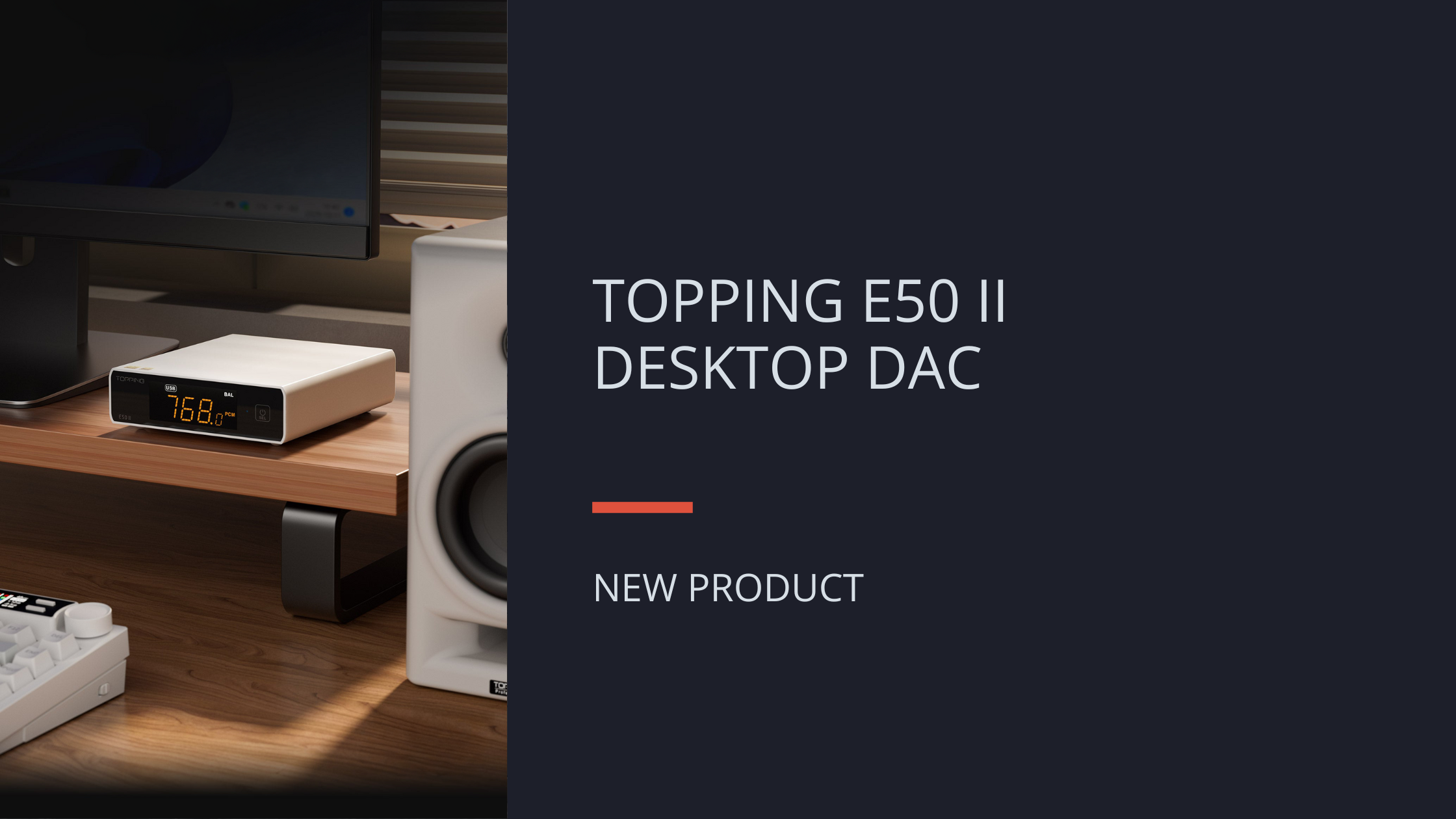
The Topping E50 II is a compact balanced desktop DAC built around AKM’s AK4497S stereo converter, an XU316 USB interface, and a flexible digital input stage that supports both S/PDIF and ADAT. Its measured performance—0.0001% THD+N at 1kHz, dynamic range up to 131dB, and jitter readings down to roughly −160dB—positions it as a transparent digital hub for powered monitors, power amplifiers, and external headphone amplifiers. With selectable output voltages, preamp functionality, LDAC-capable Bluetooth, and a ten-band parametric EQ, it functions as a small but capable control point for modern listening desks.
Compact design with broad connectivity
The E50 II is sized for desks where space matters yet still provides a full set of digital inputs. USB-C covers most computer-based sources, while coaxial and optical inputs accept S/PDIF feeds from streamers, TVs, or CD transports. The optical port also accepts ADAT, which allows the DAC to integrate with more complex studio-style signal paths. Balanced TRS and single-ended RCA line outputs make it straightforward to connect to powered monitors or downstream amplification without adapters.
AK4497S decoding and low-noise architecture
AKM’s AK4497S belongs to the updated VELVET SOUND family and is known for low distortion and high linearity. In this implementation, the DAC stage reaches 0.0001% THD+N at 1kHz and achieves up to 131dB of dynamic range. Those figures translate to an audibly quiet noise floor—quiet passages carry no added electronic hiss, and low-level spatial cues remain intact. The DAC maintains tonal consistency across PCM and native DSD formats up to DSD512.
USB performance and native DSD support
The XU316 USB processor handles PCM streams from 44.1kHz through 768kHz and native DSD64–DSD512. The platform can run driverless on macOS and uses a Thesycon driver on Windows for stable, bit-accurate transfer. High-rate PCM and DSD modes benefit users who rely on files or workflows that include upsampling, signal analysis, or measurement-driven EQ tuning.
FPGA timing and dual-format optical
Coaxial and optical signals pass through an FPGA and PLL-based TopSync circuit with JitterNull processing. This timing architecture minimizes clock error, which is particularly relevant in systems where multiple digital sources feed a single DAC. The ability of the optical port to accept both standard S/PDIF and ADAT allows the E50 II to operate in hybrid desk-and-studio environments without needing a format converter.
Wireless input with LDAC support
A Qualcomm QCC5125 chipset provides the wireless input path, supporting LDAC, aptX Adaptive, aptX HD, aptX, AAC, and SBC. LDAC transmission at up to 96kHz / 24-bit reduces the penalty associated with moving from a wired to a wireless source, which can be useful for situations where a phone or tablet is the primary playback device. The wired outputs remain fixed and clean, so the wireless link doesn’t affect downstream connections.
System tuning through parametric EQ
A ten-band parametric EQ is built into the DAC, adjustable through Topping’s Tune software or the Topping Home app. Each band offers control of frequency, gain, and bandwidth, and left and right channels can be tuned independently. Users can load target curves or corrective filters directly into the DAC, reducing the need for additional DSP hardware. The EQ operates on PCM content up to 192kHz / 32-bit.
Independent balanced and single-ended outputs
The line stage provides two selectable voltages for both output types. RCA outputs can be set to 2.6Vrms or 5.6Vrms, while balanced TRS can reach 5.3Vrms or 11.3Vrms. The independence of these levels helps with gain-matching downstream amplifiers or monitors. Noise levels remain low—down to 1.7µVrms on RCA—so the DAC can be used with high-sensitivity desktop amps without adding hum or hiss.
Preamp mode with remote control
In preamp mode, the E50 II’s output level becomes adjustable, allowing it to serve as a direct controller for power amplifiers or active loudspeakers. The included infrared remote handles volume, muting, input switching, and mode changes. This configuration minimizes the number of devices required to build a two-channel desktop chain while retaining the option of fixed-level mode for systems that already include an external controller.
Display and interaction
The front panel uses touch-sensitive controls with tap, long-press, and double-tap actions to handle core functions. The display offers three brightness levels that adapt to bright workspaces or low-light listening. The interface remains intentionally minimal—designed to provide clear status information without introducing unnecessary control layers.
Availability
The Topping E50 II is available now on Apos Audio.