How are Archive Tubes Matched?
Why NOS Vacuum Tubes Need Matching
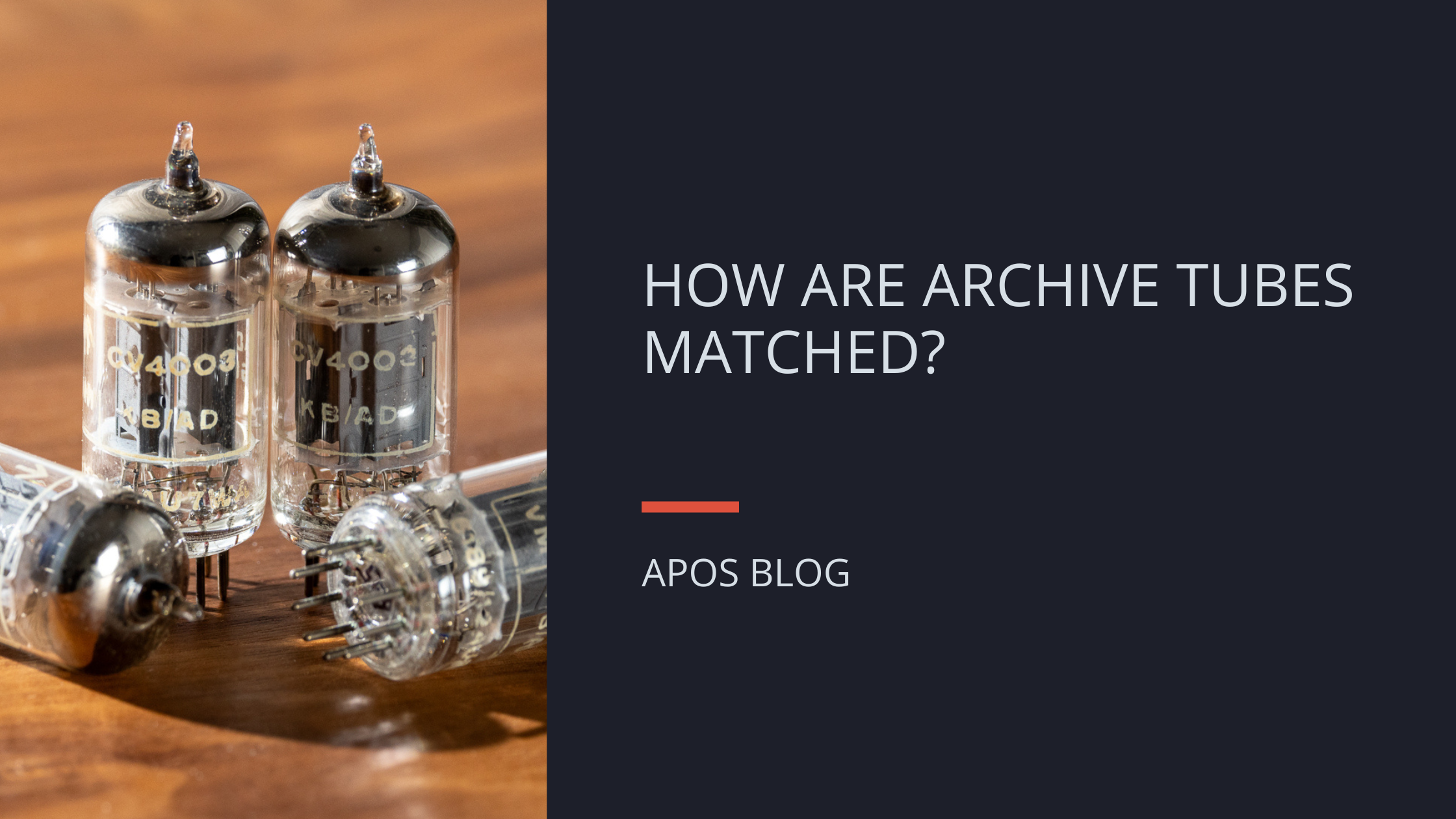
If you're new to vacuum tubes, you might have wondered about tube matching. Shouldn’t the tubes already be matched from the factory? After all, modern electronics are built to microscopic tolerances. Why aren't tubes?
The short answer: Vacuum tubes are inherently variable, especially NOS tubes made decades ago. Matching is a process we do after the tubes are tested, not something the factory could guarantee 50–70 years ago.
Let’s talk about why.
How vacuum tubes were made
Most NOS tubes from the 1940s–1980s were built using processes that involved:
- Human labor
- Manual assembly
- Heat forming
- Hand-winding grids
- Glasswork done by skilled workers
- Cathodes coated by hand with emissive material
- Seals, getters, and vacuum evacuation done with decades-old machinery
Inside a typical dual-triode tube (like a 12AU7 or 12AX7), you have two complete miniature triode systems, each with:
- Its own cathode
- Its own grid
- Its own plate
- Its own internal spacing and geometry
Workers were building two separate amplifiers in one glass bottle, by hand, thousands of times per day.
Even with careful craftsmanship, the tiniest differences mattered:
- A grid wire wound a hair tighter
- A plate bent a fraction differently
- A cathode coating slightly thicker on one side
- A filament that ran a little hotter or cooler
These variations were normal and didn’t affect the tube’s ability to pass factory QA.
Remember: these tubes were meant for radios, televisions, oscilloscopes, aircraft gear rather than audiophile stereos.
Perfect triode-to-triode symmetry was not the intended purpose, so factories never guaranteed it.
Why matching matters today
When you use a tube in an audio system, especially a stereo one, triode balance can influence:
- Channel balance
- Gain consistency
- Distortion characteristics
- How equally both halves of the tube drive the circuit
Some circuits don’t care about matching. Others—like phase splitters, long-tailed pairs, differential stages—really benefit from it.
Matching is simply a way to give you predictability, especially with NOS tubes that have been aging (and slowly drifting) for decades.
How we match
Every NOS tube is tested using an Amplitrex AT1000 Tube Tester. We measure the output of both triodes and average them. The percent difference between the two sides determines the grade.
For pairs of matched tubes, we simply take the averages of two tubes, find the percent difference between them, and determine the grade.
For quads, the process is the same but with four tubes.
We use a simple, transparent three-tier system:
Archive Vault: Match within 5%
The triodes of all tubes are performing almost identically. This is as close to “factory perfect” as old tubes get.
Gold: Match within 10%
The triodes of all tubes are still very close.
Silver: Match within 10–20%
The triodes of all tubes are more different than previous grades, but still fully healthy and within the normal range for vintage tubes.
If you have any other questions about how we match our tubes, please reach out to customer support.