Gustard X26 III vs Yulong D39: A Detailed DAC Comparison
Introduction
The Gustard X26 III and Yulong D39 are two high-performance digital-to-analog converters (DACs) that sit at the top end of desktop audio. Both units feature ESS’s flagship ES9039PRO DAC chip, high-quality power supplies, and advanced clocking designs. However, their approach to implementation, usability, and system integration differs in several important ways. This comparison explores those differences to help you decide which model better suits your listening priorities and system setup.
Architecture and Build
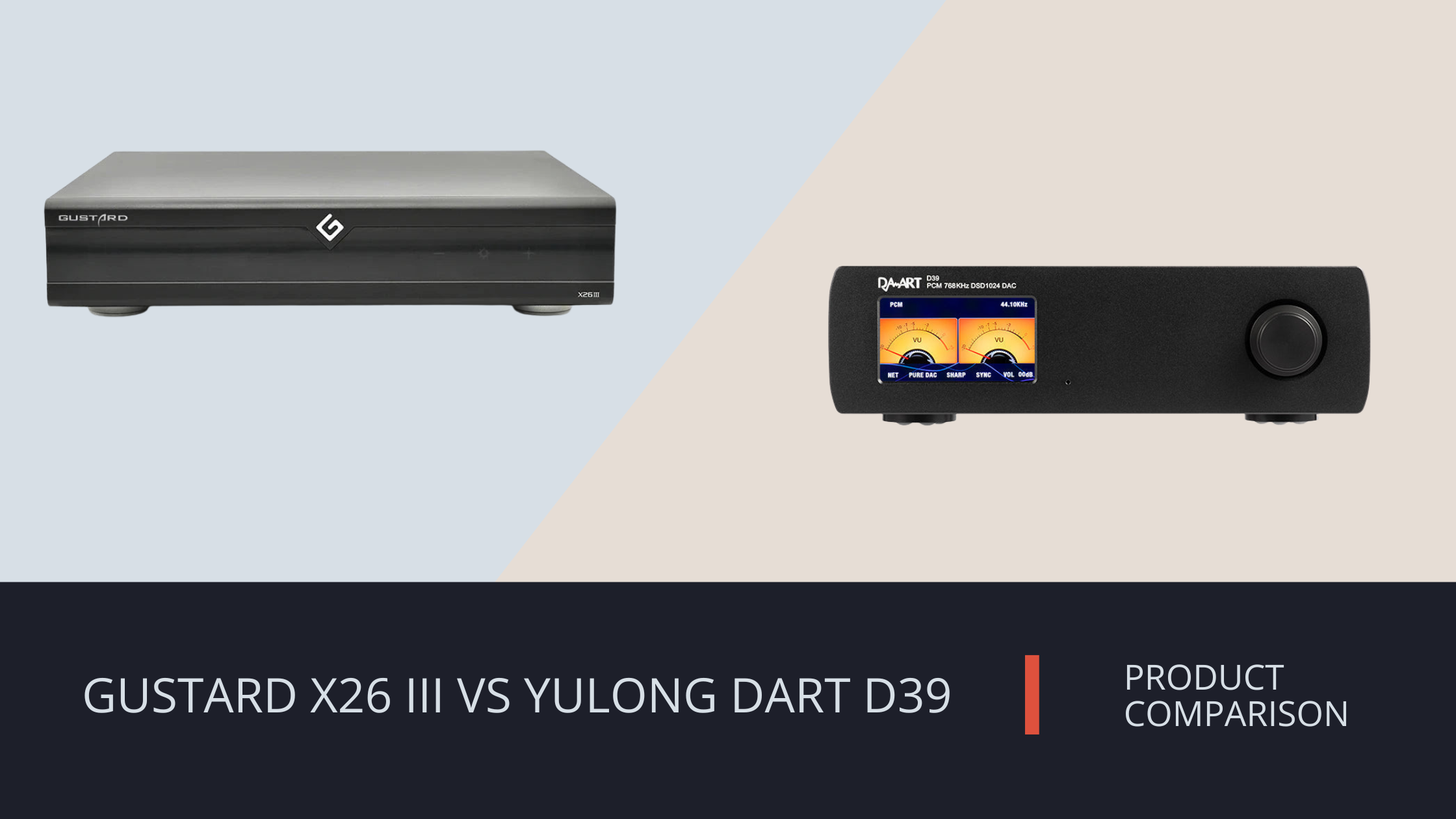
The Gustard X26 III uses two ESS9039PRO DAC chips in a fully dual-mono configuration, with one chip dedicated to each channel. Its large chassis houses dual toroidal transformers and physically separated analog and digital power sections. This design reflects Gustard’s traditional focus on heavy-duty construction and low-noise linear power delivery.
The Yulong D39 uses a single ESS9039PRO DAC chip for stereo conversion, combined with Yulong’s custom JIC FPGA platform that handles USB, network streaming, and clock management. It also features dual toroidal transformers and discrete regulation circuits, but its chassis is smaller and lighter, making it easier to fit into compact setups.
In short, the Gustard emphasizes raw component separation and power delivery, while the Yulong integrates digital control and processing in a more compact and efficient enclosure.
Clocking and Digital Design
The X26 III includes an internal femtosecond-grade clock and a 10 MHz BNC input for connection to an external master clock. This option gives users flexibility in systems where clock synchronization is critical.
The D39, on the other hand, includes both word-clock input and output, allowing it to act as either a master or a slave clock within a digital chain. Its FPGA-based USB and SPDIF handling bypasses generic USB receiver chips, reducing potential digital noise.
Both units place strong emphasis on clock integrity, but their methods differ. The Gustard favors external clock compatibility for precision tuning, while the Yulong focuses on minimizing jitter internally through FPGA timing control.
Analog Output Stage and Performance
The X26 III’s analog stage is built around discrete output circuitry with an output impedance of around 100 ohms. It offers both fixed and variable output modes, allowing it to function as a DAC or as a digital preamplifier. The measured distortion levels are extremely low, with total harmonic distortion plus noise (THD+N) around 0.0001 percent and a signal-to-noise ratio exceeding 127 decibels.
The D39’s output impedance is slightly higher, at approximately 200 ohms, and it provides adjustable output levels to better match amplifiers or powered speakers. Its published specifications are similarly impressive, with THD+N around 0.0001 percent and an SNR of roughly 125 decibels.
In practice, both DACs deliver transparent and detailed sound, though systems with very low input impedance amplifiers may favor Gustard’s lower output impedance.
Features and Streaming Capabilities
Both the X26 III and D39 include built-in network streaming via Ethernet. They support popular protocols such as DLNA, Roon, and AirPlay, allowing users to stream directly from local or networked sources.
The X26 III adds selectable digital filters and a non-oversampling (NOS) mode for users who like to fine-tune transient behavior and tonal response. The D39, by contrast, offers a more advanced display with spectrum visualization and system information. It also runs a lightweight Linux-based architecture that isolates streaming tasks from the DAC’s analog section to reduce interference.
If your priority is customization and tonal adjustment, the X26 III offers more flexibility. If you prefer simplicity, smooth integration, and a refined user interface, the D39 takes the lead.
Usability and Design
The Gustard X26 III is a physically large unit with a minimalist front panel and an OLED display. It is designed to be part of a full-size audio rack or system. The Yulong D39, by contrast, is smaller and lighter, featuring a bright color display and a single multifunction control knob.
The X26 III’s heavier build and internal layout reflect a more traditional audiophile design philosophy, while the D39 feels more modern and practical for desktop or compact setups.
Sound and System Synergy
Given their shared ESS9039PRO architecture and low distortion, differences in measured performance are marginal. However, their design philosophies can produce subtle tonal distinctions.
The X26 III, with its dual-mono configuration and NOS filter options, tends to sound slightly more spacious and customizable. Listeners who like to experiment with different filters may find its flexibility appealing.
The D39’s FPGA-based processing and compact design emphasize purity and noise isolation. It may offer a slightly quieter background and tighter imaging in systems that are sensitive to digital noise or ground interference.
Ultimately, the sonic differences are minor compared to the influence of your amplifier, speakers, and cables. The choice comes down to system matching and personal preference.
Conclusion
Both the Gustard X26 III and Yulong D39 are exceptional DACs built for demanding listeners. The X26 III is the more traditional audiophile component, with a focus on power supply isolation, customization, and external clock integration. The D39 is more compact and modern, emphasizing internal digital control, USB and network isolation, and ease of use.
Choose the Gustard X26 III if you want:
- Dual-mono analog architecture
- External clock compatibility
- Non-oversampling and digital filter control
- Use as a DAC or digital preamp
Choose the Yulong D39 if you value:
- FPGA-controlled digital processing
- Compact form factor
- Integrated streaming and user-friendly interface
- Word-clock input and output flexibility
Both deliver reference-grade transparency and precision. The better choice depends on your setup—whether you prefer the adjustability and weight of the Gustard or the integration and simplicity of the Yulong.