FiiO K13 R2R vs FiiO K17
How two compact FiiO desktop DAC/amps differ in design, performance, and purpose
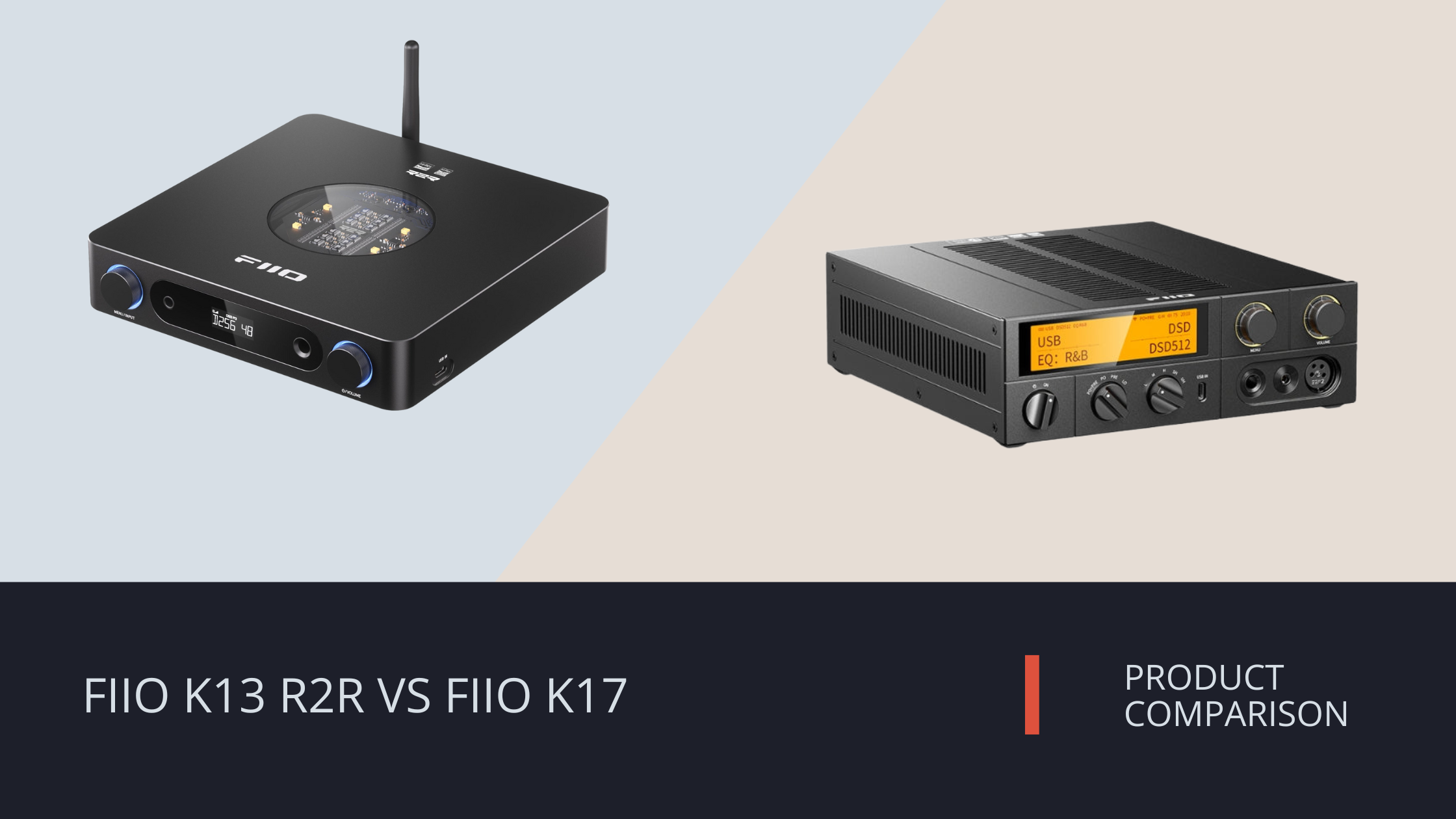
In this post, we’ll walk through how the FiiO K13 R2R and FiiO K17 differ in architecture, output power, and system flexibility—and where each model fits best in a desktop listening chain.
Both serve as all-in-one DAC/amps aimed at headphone listeners, but they take different engineering approaches. The K13 leans into a discrete R2R ladder with a warmer tonal profile, while the K17 continues FiiO’s delta-sigma line with higher power and broader connectivity.
Overview
The FiiO K13 R2R is a desktop DAC/amp that centers on a fully differential 24-bit R2R resistor ladder. A dual-stage amplification design, analog-leaning presentation, and discrete architecture give it a different character from FiiO’s chip-based models. With balanced 4.4 mm and single-ended 6.35 mm outputs, selectable NOS/OS modes, and USB plus S/PDIF inputs, it is designed for headphone chains where tone and timbre matter.
The FiiO K17 uses dual ESS DAC chips, higher output power, a larger display, and more DSP features. Its amplification stage is built for difficult headphones, and its digital architecture supports PEQ, filters, and richer device control. It also offers both USB-C and full-size USB inputs, Bluetooth, and more robust preamp functions.
In broad terms:
- The K13 emphasizes discrete R2R conversion and a warmer, smoother character.
- The K17 prioritizes output power, digital control, and versatility in system integration.
Architecture & Conversion Approach
K13 R2R — Fully Differential 24-bit Ladder DAC
The K13 uses a discrete 24-bit resistor ladder with matched components for each bit weight. This architecture avoids noise-shaping and delta-sigma modulation, relying instead on precision resistors and switching networks. FiiO’s implementation includes:
- matched resistor networks
- fully differential signal paths
- selectable NOS (non-oversampling) and OS processing
Why it matters:
R2R systems trade absolute measured performance for a specific presentation—denser midrange, softer transients, and a more analog sense of weight. The NOS mode further reduces digital pre-ringing and filtering artifacts.
K17 — Dual ESS Delta-Sigma DACs
The K17 employs dual ESS chips (ES9069Q), using parallel conversion for lower noise and a neutral, linear response. Digital filters, PEQ, and DSP-based control give users finer control over output behavior.
Why it matters:
Delta-sigma conversion delivers cleaner measurements, lower distortion, and a more defined high-frequency edge. It also enables features such as adjustable filters, configurable gain, and more consistent channel matching.
Both approaches aim for fidelity, but the K13 focuses on a discrete tonal signature, while the K17 targets maximum neutrality and extension.
Features & Connectivity Comparison
| Feature | FiiO K13 R2R | FiiO K17 |
|---|---|---|
| DAC architecture | 24-bit fully differential R2R ladder | Dual ESS ES9069Q |
| Outputs | 4.4 mm balanced, 6.35 mm SE, XLR/RCA line outs (var/fixed) | 4.4 mm balanced, 6.35 mm SE, XLR/RCA line outs (var/fixed) |
| Output power (bal) | ~2.4 W @ 32Ω | ~2.7 W @ 32Ω (High Gain) |
| Output power (SE) | ~600 mW @ 32Ω | ~550 mW @ 32Ω |
| Inputs | USB-C ×2, Coaxial, Optical | USB-B, USB-C, Coaxial, Optical, Bluetooth |
| Bluetooth | None | LDAC / AAC / SBC |
| Display | Small front display | Larger full-color display |
| DSP / Filters | NOS/OS only | PEQ, filters, gain control |
| Use case | R2R tone, headphone listening | All-rounder with more features |
| Form factor | Compact desktop | Larger, full-function desktop |
Performance Comparisons & Trade-offs
Noise Floor & Dynamic Behavior
The K17’s delta-sigma DACs measure cleaner, with lower THD+N and a higher signal-to-noise ratio. ESS conversion also maintains linearity across more loads and frequencies.
The K13, while still quiet, follows the typical R2R profile: slightly higher noise floor, smoother high-frequency response, and softer edges on transients.
For listeners who prioritize absolute linearity, the K17 behaves more consistently. For listeners who prefer a rounded and weighty presentation, the K13’s R2R system offers that character.
Output Power & Headphone Pairing
Both units deliver desktop-class power, but their behavior differs:
K17 delivers higher power at high gain and handles low-sensitivity planar headphones with more headroom.
K13 offers strong, balanced output but leans toward dynamic-driver headphones and moderate-sensitivity planars where tonal density matters more than raw voltage swing.
If your chain includes headphones like HIFIMAN Sundara, Arya, or HD600-series, both work well. For more demanding flagships, the K17 has the advantage.
Control & Interface
The K17 includes:
- PEQ
- multiple filters
- Bluetooth control
- more detailed UI
- system-level configuration
The K13 is simpler, with NOS/OS toggles and a smaller display.
For users who want fine-grained control, the K17 is the more flexible device.
System Integration
If you prefer a DAC/amp that also serves as a lightweight preamp:
K17 fits better due to gain options, filter adjustments, and digital control.
K13 works well as a tone-focused DAC feeding a dedicated amplifier.
Where Each Makes the Most Sense
Choose the K13 R2R if:
- You want a warmer, more analog-leaning presentation
- You prefer NOS/OS switching without DSP layers
- Your headphones don’t require high-current amplification
- You want R2R sound in a compact desktop footprint
Choose the K17 if:
- You need more features, including Bluetooth and PEQ
- You use planars and low-sensitivity headphones
- You want neutral, measured performance
- You need preamp functionality for powered monitors
Product Highlights
FiiO K13 R2R
- Fully differential 24-bit R2R ladder DAC
- NOS/OS modes
- Balanced 4.4 mm and SE 6.35 mm headphone outputs
- XLR and RCA line outputs
- USB-C ×2 plus coaxial/optical inputs
- ~2.4 W + 2.4 W @ 32Ω balanced output
- Compact desktop design
FiiO K17
- Dual ESS ES9069Q DAC chips
- PEQ, filters, gain control
- Balanced 4.4 mm and SE 6.35 mm headphone outputs
- XLR and RCA line outputs
- USB-B, USB-C, optical, coaxial, and Bluetooth
- ~2.7 W @ 32Ω balanced
- Larger, full-function desktop interface
Conclusion
The FiiO K13 R2R and FiiO K17 serve different priorities within the same category.
The K13 focuses on discrete conversion, tonal weight, and a compact design. It works best for listeners who want an R2R signature and primarily use headphones that do not require extreme power.
The K17 expands on the digital side: stronger DSP tools, broader connectivity, higher total output power, and more robust preamp functionality. It suits listeners who value neutrality, control, and flexibility.
In short:
- K13 R2R → best for analog-leaning headphone listening with a smoother, warmer presentation.
- K17 → best for users who want more control, more power, and a neutral baseline for varied systems.
Both deliver strong desktop performance, but they excel in different contexts depending on your preferred sound profile and system requirements.