FiiO K13 R2R vs FiiO K7
How two desktop FiiO DAC/amps differ in design, conversion approach, and system role
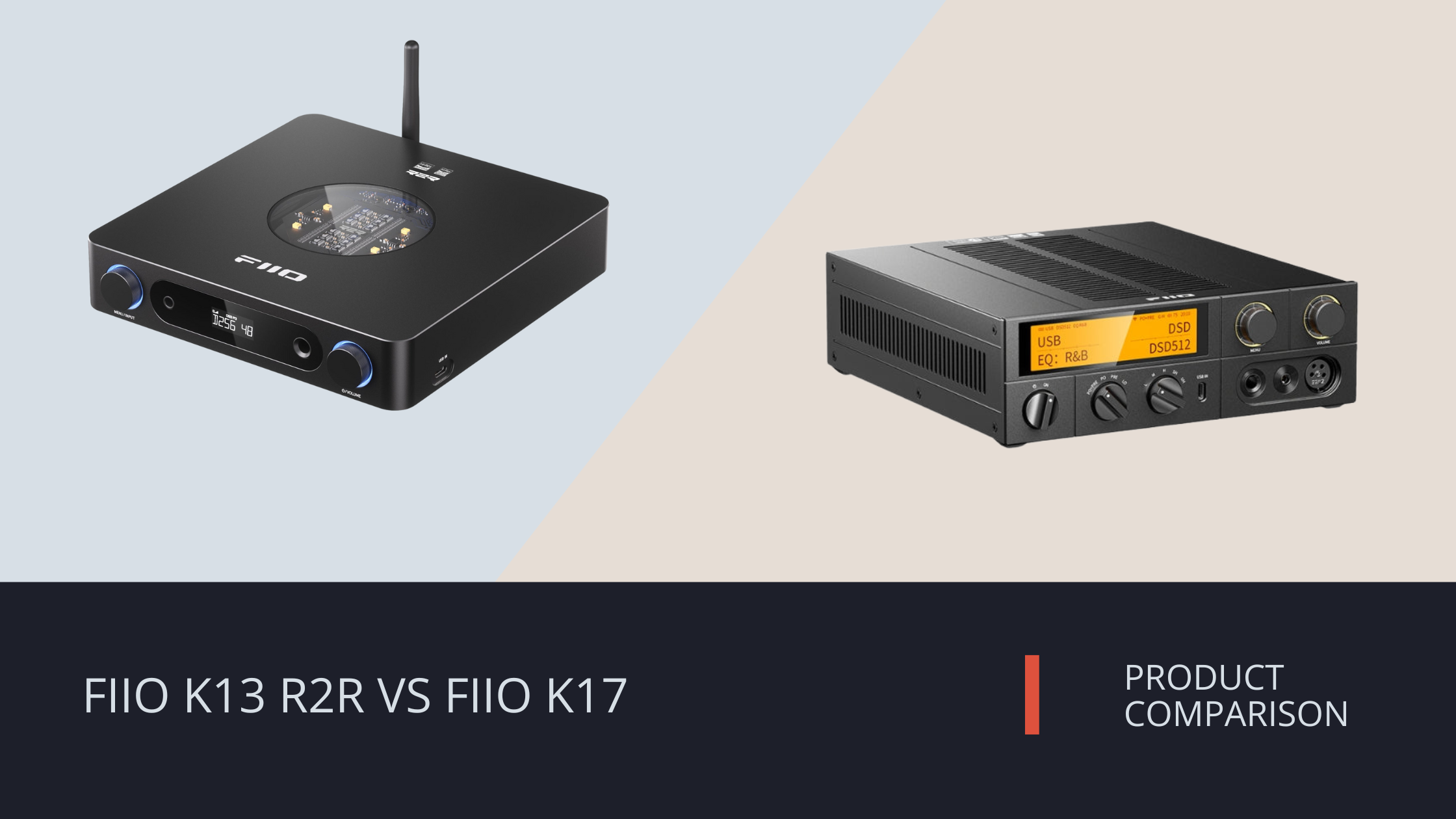
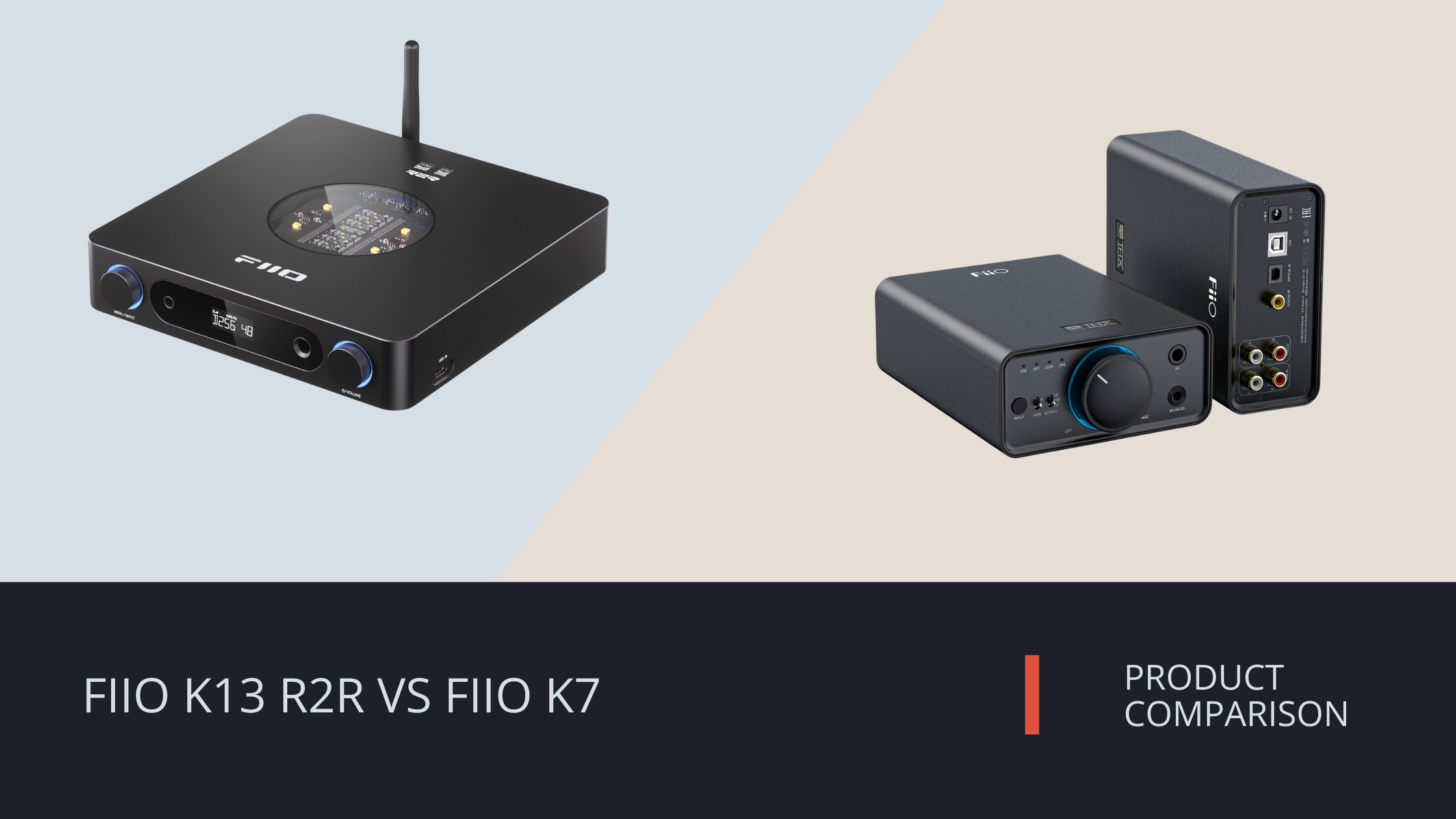
In this post, we’ll walk through how the FiiO K13 R2R and the FiiO K7 differ in architecture, measured characteristics, and day-to-day usability—and where each fits best on a desktop headphone chain.
Overview
The FiiO K13 R2R is a fully balanced desktop DAC/amp using a discrete 24-bit ladder DAC stage. It’s designed for listeners who prefer a linear, resistor-based conversion approach instead of delta-sigma modulation. With up to 3.6 W into 32Ω, selectable gain modes, and a compact aluminum chassis, it serves as a transparent, neutral front end for mid-to-high-efficiency headphones.
The FiiO K7 is a balanced delta-sigma DAC/amp built around dual AK4493SEQ chips and dual THX AAA 788+ amplifier modules. It focuses on low noise, consistent linearity, and fully balanced drive at an accessible price point. USB, coaxial, optical, and line inputs give it broad source compatibility for desktop use.
In rough terms:
- K13 R2R: discrete ladder DAC, neutral tuning, strong power, and a compact form factor.
- K7: delta-sigma architecture with THX AAA amplification for low distortion and balanced drive.
Architecture & Conversion Approach
K13 — 24-bit R2R ladder DAC
The K13 uses a resistor-ladder architecture with precisely matched components to generate each output level directly. This avoids conventional noise-shaping and modulator stages. The design emphasizes linearity and stable low-level detail. An OPA1662-based low-pass stage and robust output stage maintain channel matching and dynamic range.
This architecture appeals to listeners who prefer discrete conversion with predictable behavior across sample rates.
K7 — Dual AK4493SEQ with THX AAA 788+
The K7 implements two AK4493SEQ DAC chips in a fully balanced configuration. These chips use multi-bit delta-sigma modulation, enabling low distortion, high dynamic range, and consistent performance across PCM and DSD formats. The THX AAA 788+ amplifier modules provide low-noise, low-output-impedance current drive with minimal crossover distortion.
This combination targets clarity, low noise, and balanced output capability for a wide range of headphones.
Both units are engineered for neutral, linear output, but the K13 delivers it through discrete resistor arrays, while the K7 takes advantage of high-efficiency integrated delta-sigma conversion and THX current-feedback modules.
Features & Connectivity Comparison
| Feature | FiiO K13 R2R | FiiO K7 |
|---|---|---|
| DAC architecture | 24-bit R2R ladder | Dual AK4493SEQ delta-sigma |
| Amp architecture | Discrete amp stage | Dual THX AAA 788+ |
| Balanced headphone out | 4.4mm + XLR-4 | 4.4mm + XLR-4 |
| SE headphone out | 6.35mm | 6.35mm |
| Max power (balanced) | ~3.5 W @ 32Ω | ~2.0 W @ 32Ω |
| Max power (SE) | ~1.2 W @ 32Ω | ~1.3 W @ 32Ω |
| Gain modes | 2-stage (Low/High) | 2-stage (Low/High) |
| Digital inputs | USB-C, coaxial, optical | USB-B, coaxial, optical |
| Line out | RCA | RCA |
| Display | OLED | RGB volume indicator |
| Supported formats | PCM / DSD | PCM 384 kHz / DSD256 |
| Bluetooth | No | No |
Performance Characteristics & Trade-offs
Noise floor and resolution
The K7 benefits from THX AAA amplification, which suppresses noise and distortion across the gain cycle. This results in a stable, low noise floor suited for sensitive IEMs.
The K13’s discrete R2R stage maintains linearity without aggressive noise shaping, producing stable mid-band resolution and consistent behavior with higher-impedance headphones.
Output power and drive
The K13 delivers more power from its balanced output, making it better suited for planar headphones or dynamics with higher current requirements.
The K7’s THX modules offer controlled drive with low output impedance, excelling with modern, efficient headphones and IEMs.
System integration
The K13 works well as an all-in-one for users who prefer R2R conversion in a small desktop footprint.
The K7 is a strong general-purpose balanced DAC/amp with predictable behavior across sources and headphones.
Where Each Makes the Most Sense
Choose the K13 R2R if:
- You prefer a resistor-ladder DAC topology
- You want more power for planars or inefficient headphones
- You need a compact, balanced desktop DAC/amp with a neutral output
- Discrete conversion is a priority
Choose the K7 if:
- You want THX AAA amplification for low noise and stable output
- You prefer the predictability of AKM delta-sigma DACs
- You want maximum value in a balanced all-in-one
Product Highlights
FiiO K13 R2R
- 24-bit R2R ladder DAC
- OPA1662 low-pass stage
- ~3.5 W @ 32Ω (balanced)
- USB-C, coaxial, and optical inputs
- RCA line out
- 4.4mm, XLR-4, and 6.35mm headphone outs
- Two gain modes
- Compact aluminum chassis
FiiO K7
- Dual AK4493SEQ DACs
- Dual THX AAA 788+ modules
- ~2.0 W @ 32Ω (balanced)
- USB-B, coaxial, and optical inputs
- RCA line out
- 4.4mm, XLR-4, and 6.35mm headphone outs
- Two gain modes
- Balanced internal architecture
Specs
FiiO K13 R2R
- DAC: 24-bit R2R ladder
- USB input: USB-C
- Outputs: 4.4mm, XLR-4, 6.35mm, RCA
- Power: ~3.5 W @ 32Ω (balanced)
- THD+N: <0.002% (typical)
- Supported formats: PCM / DSD via USB
FiiO K7
- DAC: Dual AK4493SEQ
- Amp: THX AAA 788+
- Inputs: USB-B, optical, coaxial
- Outputs: 4.4mm, XLR-4, 6.35mm, RCA
- Power: ~2.0 W @ 32Ω (balanced)
- THD+N: <0.0003%
- Supported formats: PCM up to 384 kHz / DSD256