
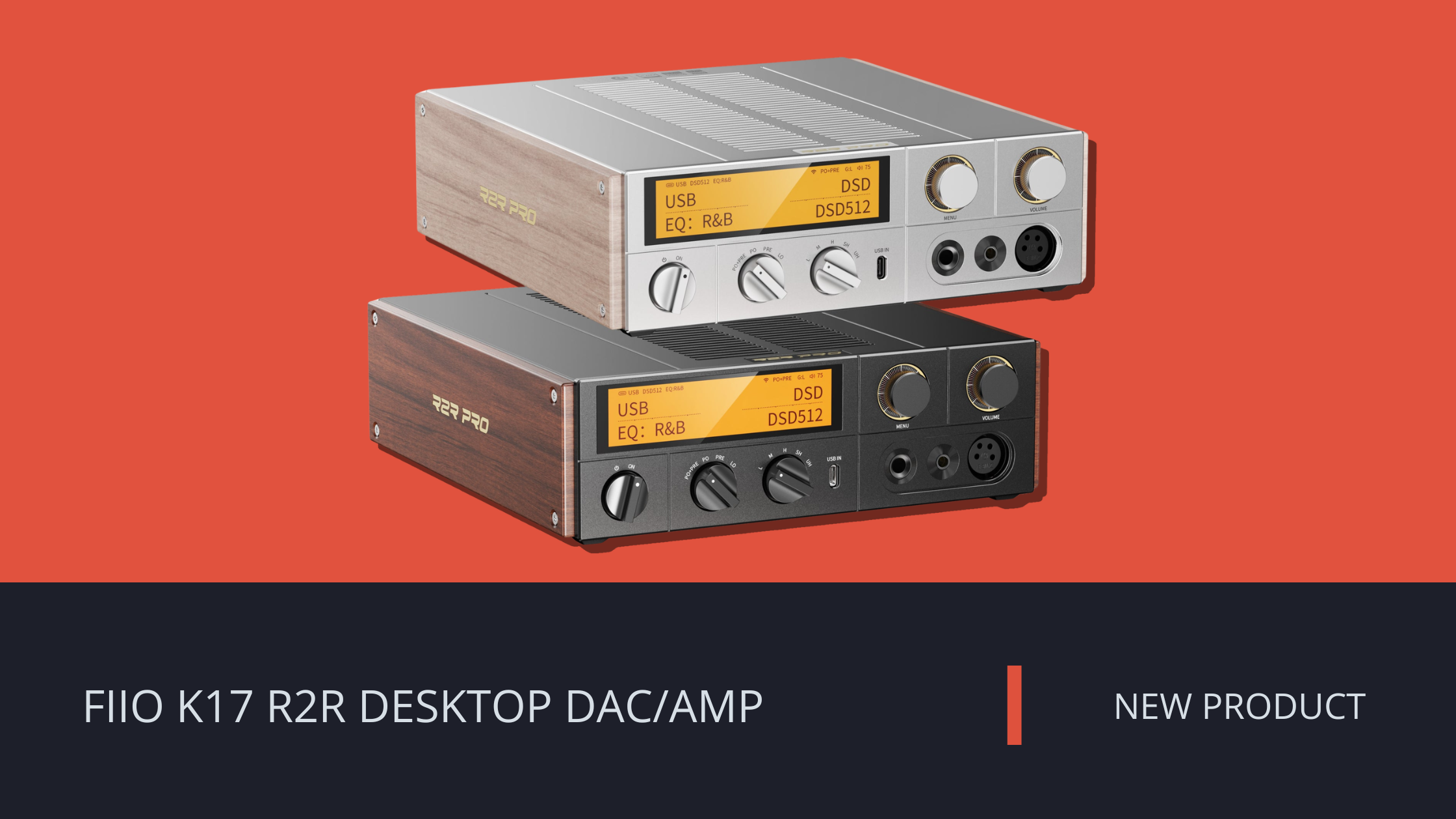
NEW: FIIO K17 R2R DESKTOP DAC/AMP
R2R desktop audio hub
The FiiO K17 R2R is an all-in-one desktop DAC, network streamer, preamplifier, and headphone amplifier built around FiiO's proprietary 24+5-bit segmented R2R PRO resistor array. Its fully-balanced signal path feeds a discrete Class AB headphone amplifier capable of 4,000mW per channel into 32 ohms from the balanced output, while an XMOS XU316 USB interface handles PCM up to 768kHz/32-bit and native DSD256. Network playback, eight operating modes, and a dedicated DSP with 31-band parametric EQ allow the K17 R2R to operate as the central source and control component in headphone systems, powered speaker systems, and two-channel installations.
A 24+5-bit segmented R2R conversion architecture
Traditional R2R DACs derive output from a network of precisely matched resistors, making resistor tolerances and cumulative ladder errors important factors in conversion accuracy. FiiO uses thermometer-coded decoding for the upper five bits, reducing the accumulated errors associated with conventional ladder implementations while retaining an R2R conversion architecture.
The DAC stage forms part of a fully-balanced circuit extending through current-to-voltage conversion, low-pass filtering, and headphone amplification. Multiple low-noise Texas Instruments operational amplifiers are used throughout these stages to maintain channel separation, dynamic range, and low distortion. The K17 R2R specifies an A-weighted signal-to-noise ratio of at least 125dB, an A-weighted noise floor below 2.6μV, and THD+N below 0.0052% at 1kHz, -8dB, and a 32-ohm load.
Discrete Class AB amplification for headphones
The headphone amplifier uses a fully discrete op-amp plus transistor current amplification stage with ON Semiconductor MJE243 and MJE253 output transistors. This architecture provides the current required by lower-impedance headphones while maintaining low output impedance for more sensitive loads. Balanced output power reaches 4,000mW + 4,000mW into 32 ohms, with 1,850mW + 1,850mW available from the single-ended output at the same impedance.
For higher-impedance headphones, the K17 R2R delivers 950mW + 950mW into 300 ohms from its balanced output and 240mW + 240mW single-ended. Integrated protection monitors amplifier temperature, transformer temperature, output overload, DC offset, and incoming power conditions, protecting the amplifier stage and connected headphones during abnormal operating conditions.
31-band PEQ across all operating modes
A dedicated M21586Q DSP operates at 360MHz and performs 64-bit floating-point processing, enabling a 31-band parametric equalizer across all eight operating modes. Gain and Q values can be adjusted at individual frequency bands, with additional controls for dynamic range processing, limiters, and compressors. The DSP architecture applies these functions without unnecessary sample-rate conversion, preserving the incoming digital format through the processing path where supported.
AUTO EQ provides selectable target response correction for headphones, alongside built-in presets for different listening preferences. Each frequency band remains manually adjustable, and PEQ profiles can be imported, exported, and shared. This allows the K17 R2R to handle headphone correction and system-specific frequency response adjustments internally rather than relying on host-side EQ software.
Network, USB, and local playback
The K17 R2R supports Roon Ready playback, AirPlay, QPlay, and network storage over SMB and NFS. Gigabit Ethernet and dual-band Wi-Fi provide the network connection, with streaming playback supporting PCM up to 384kHz/32-bit and DSD256 via DoP. Local playback supports PCM up to 384kHz/32-bit and DSD256.
For direct computer audio, an XMOS XU316 USB interface increases maximum decoding support to 768kHz/32-bit PCM and native DSD256. A Qualcomm QCC5125 Bluetooth chipset provides Bluetooth 5.1 reception with SBC, aptX, aptX LL, aptX HD, aptX Adaptive, and LDAC codec support. Optical and coaxial digital inputs are also available for dedicated transports, televisions, and other digital sources.
Eight modes for digital and analog systems
Dedicated operating modes cover network streaming, local playback, USB DAC operation, Bluetooth reception, optical input, coaxial input, balanced analog input, and single-ended analog input. The analog inputs allow existing source components to use the K17 R2R's preamplifier and headphone amplification stages, while RCA and balanced XLR outputs connect the unit to powered speakers or downstream amplifiers.
Line output is specified at 2.5Vrms over RCA and 5Vrms over XLR. Together with the headphone outputs and multiple input modes, this allows the K17 R2R to move between direct headphone use and line-level duties without requiring a separate DAC, streamer, or preamplifier for each source.
Separated power, digital, and analog sections
FiiO separates the K17 R2R's digital, analog, and power supply circuits across independent circuit boards to reduce interference between subsystems. A custom 35W linear transformer supplies the unit, with five 4,700μF capacitors providing current reserves for the audio circuitry. Analog and digital supplies are separated and use multi-stage voltage regulation with low-noise LDO regulators to limit power supply noise reaching sensitive conversion and amplification stages.
Three ultra-low phase-noise femtosecond oscillators handle timing for different digital sampling frequencies, including two ACCUSILICON AS318-L clocks. Dedicated clocks reduce timing error at the digital conversion stage rather than deriving every sample-rate family from a single clock source. Nichicon, ELNA, Rubycon, Panasonic, and WIMA components are used through the analog circuitry, alongside silver-plated oxygen-free copper wiring and gold-plated Neutrik connectors.
Touchscreen and dedicated hardware controls
An Ingenic X2000 processor works alongside an ESP32-S3 controller to manage network functions, system navigation, and the user interface. A 3.93-inch LCD touchscreen provides direct access to playback and system controls, while five dedicated knobs retain hardware adjustment for frequently used functions. The K17 R2R can also be operated with the included aluminum infrared remote or through the FiiO Control app.
The chassis combines precision-machined aluminum with genuine North American hardwood side panels. Silver units use white ash, while black units use black walnut. Natural grain variation means the appearance of the wood panels differs between individual units.
Availability
The FiiO K17 R2R is available now on Apos.