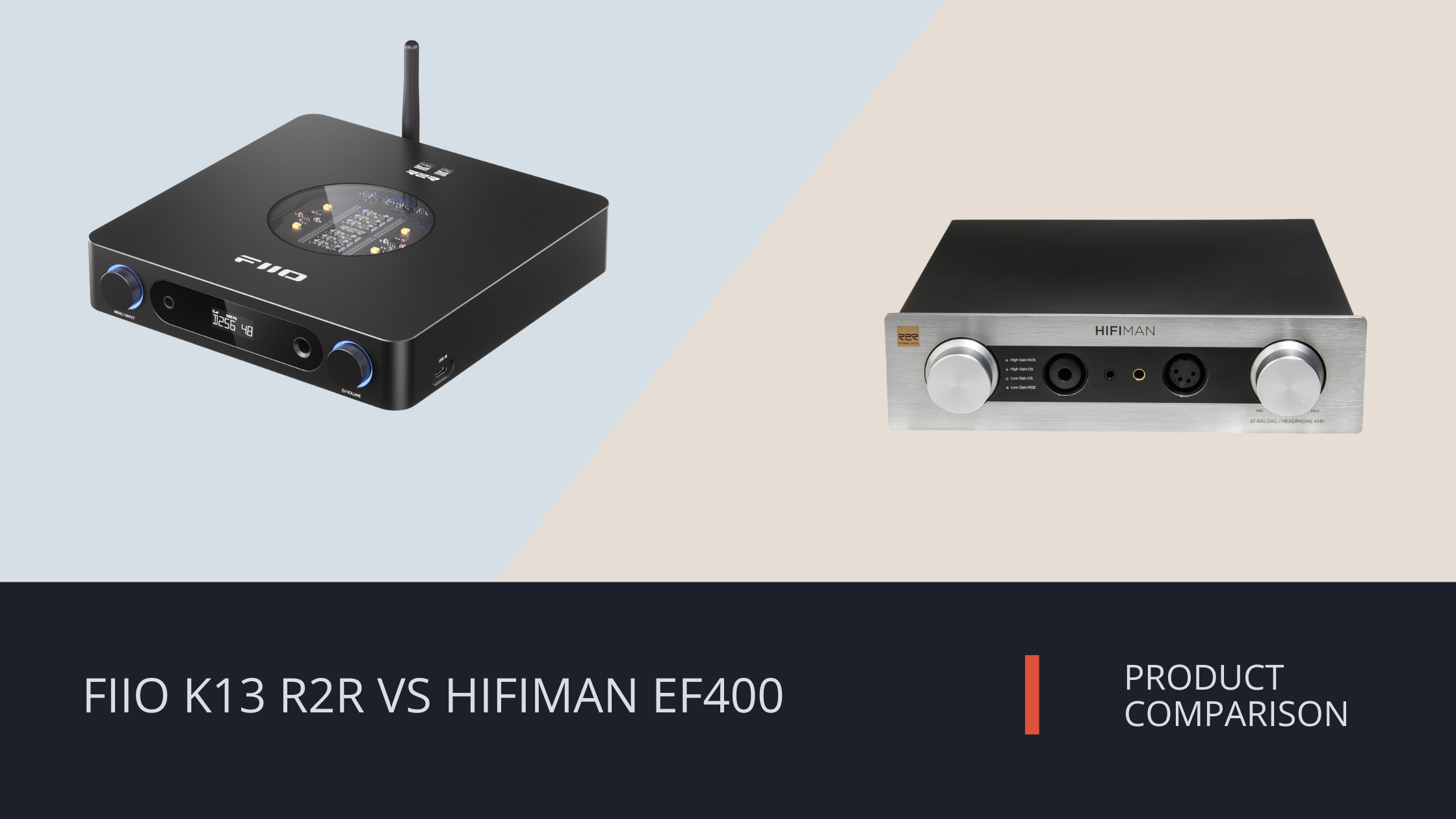
FiiO K13 R2R Desktop DAC/Amp vs HIFIMAN EF400 Desktop DAC/Amp
How two compact desktop DAC/amps differ in design, conversion approach, and real-world pairing
In this post, we’ll walk through how the FiiO K13 R2R and the HIFIMAN EF400 diverge in architecture, output design, and day-to-day usability—and where each lands in a modern headphone chain.
Overview
The FiiO K13 R2R is a fully balanced desktop DAC/amp built around a 24-bit discrete R2R ladder with selectable NOS/OS modes and a 10-band parametric EQ. It targets listeners who want tuning control, quiet low-gain behavior, and a compact form that can anchor a headphone-first desk. Its balanced output offers roughly 2.4 W per channel at 32Ω, with clean I/V conversion and a dual-USB input layout.
The HIFIMAN EF400 takes a different path. It uses HIFIMAN’s Himalaya R2R DAC module and a higher-power Class A/AB hybrid amplifier stage that can deliver up to 4.4 W into 32Ω. The EF400 is built for high-current delivery on difficult headphones and a more analog-leaning conversion style, with fewer digital conveniences and no EQ.
In broad terms:
- The K13 R2R focuses on control, flexibility, and a modern digital feature set.
- The EF400 emphasizes power, simplicity, and HIFIMAN’s house R2R tuning.
Architecture & Conversion Approach
K13 R2R — Fully differential 24-bit R2R ladder
The K13 uses a discrete resistor ladder with matched precision elements in a fully differential configuration. NOS and OS modes allow the listener to choose between unfiltered, time-domain-focused playback or oversampled reconstruction for reduced aliasing. A discrete analog output stage supports its balanced topology, while dual USB-C inputs handle PC and mobile sources independently.
Why it matters:
A discrete ladder avoids delta-sigma noise shaping, offering a more stable time response. NOS mode preserves transient edges; OS mode reduces high-frequency noise. The PEQ system allows for bandwidth and gain corrections without leaving the digital domain.
EF400 — Himalaya R2R with high-current analog stage
The EF400 uses the Himalaya R2R module—HIFIMAN’s in-house discrete ladder built for low power draw and smooth error distribution. The DAC is coupled directly to a high-current Class A/AB hybrid amplifier capable of delivering several watts into low impedances. The signal path remains relatively simple: no digital filters beyond the DAC, no oversampling controls, and no EQ.
Why it matters:
The EF400’s strength comes from its current delivery. Planar-magnetic headphones benefit from the available wattage and the amplifier’s low output impedance. The Himalaya DAC has a consistent, stable ladder operation that tends to produce a slightly rounded treble edge compared to steeper digital filters.
Output Behavior & Gain Structure
K13 R2R
The K13’s balanced output tops out at roughly 2.4 W + 2.4 W at 32Ω. Its low-gain setting keeps noise minimal with sensitive IEMs, while high gain comfortably drives most dynamic and planar headphones. The PEQ and NOS/OS modes give the listener direct control over tonal corrections.
Use-case fit:
Ideal for mixed headphone collections, including IEMs. Its lower noise floor and feature set make it a flexible desktop hub.
EF400
The EF400 reaches up to ~4.4 W at 32Ω from its balanced output—substantially higher than the K13. It is biased for current delivery and built to handle hard-to-drive planars. Noise floor is higher than the K13 on sensitive IEMs, and there is no gain control to reduce that noise.
Use-case fit:
Well-suited for planars such as the HIFIMAN Sundara, Edition XS, Arya, and HE6-style loads. Less ideal for sensitive BA IEMs.
Features & Connectivity Comparison
| Feature | FiiO K13 R2R | HIFIMAN EF400 |
|---|---|---|
| DAC architecture | Fully differential 24-bit R2R ladder | Himalaya R2R ladder |
| Amp topology | Discrete analog stage | High-current Class A/AB hybrid |
| Balanced HP out | 4.4 mm | 4-pin XLR |
| SE HP out | 6.35 mm | 6.35 mm |
| Max power (bal) | ~2.4 W @ 32Ω | ~4.4 W @ 32Ω |
| Line outputs | XLR + RCA (variable/fixed) | None (headphone amp only) |
| USB inputs | Dual USB-C | USB-B |
| Other inputs | Optical, coaxial | None |
| Bluetooth | None | None |
| EQ | 10-band PEQ | None |
| NOS/OS | Yes | Fixed DAC behavior |
| Display | OLED | No display |
| Digital controls | Filters, PEQ, gain | Simple toggle controls |
Performance Comparisons & Trade-offs
Noise floor and system versatility
The K13 maintains a lower noise floor in low gain, making it more appropriate for IEMs or headphones with high sensitivity. The EF400 trades noise control for power, offering better headroom on inefficient planar-magnetic models.
Power delivery and load handling
The EF400’s amplifier is significantly stronger. If a headphone demands high current or responds well to Class A/AB biasing, the EF400 holds a clear advantage. The K13 supplies enough power for the majority of mainstream audiophile headphones, but not to the same headroom level.
Digital features and fine-tuning
The K13’s PEQ, NOS/OS modes, and multiple digital inputs create a modern workflow that rewards listeners who want control over their signal chain. The EF400 offers a more minimal, analog-first approach.
Form factor and heat behavior
The K13 runs cool and compact, suited for desks with limited space. The EF400 runs warmer due to its biasing and has a larger footprint.
Where Each Makes Most Sense
- If you want tonal control and digital flexibility:
Choose the K13 R2R. Its PEQ, USB-C inputs, and NOS/OS modes offer a broader toolset. - If your headphones need high current:
The EF400 provides more wattage and a higher-bias amplifier for planar loads. - If you use IEMs or low-impedance headphones:
The K13’s low-gain noise floor makes it the safer pairing. - If you value simplicity and analog flow:
The EF400 keeps controls minimal and focuses on raw output capability.
Product Highlights
FiiO K13 R2R
- 24-bit fully differential R2R ladder
- ~2.4 W + 2.4 W @ 32Ω (balanced)
- Balanced XLR + RCA line outputs
- Dual USB-C inputs
- NOS/OS modes
- 10-band PEQ and OLED display
HIFIMAN EF400
- Himalaya R2R module
- Up to ~4.4 W @ 32Ω (balanced)
- High-current Class A/AB hybrid amplifier
- USB-B input
- Minimal signal path with no EQ or filters
- Strong planar-magnetic pairing behavior
Specs
FiiO K13 R2R
- DAC: 24-bit discrete R2R
- Output power (bal): ~2.4 W @ 32Ω
- Outputs: 4.4 mm, 6.35 mm, XLR, RCA
- Inputs: USB-C ×2, optical, coaxial
- USB decoding: PCM up to 384 kHz, DSD256
- Features: PEQ, NOS/OS, OLED display
HIFIMAN EF400
- DAC: Himalaya R2R
- Output power (bal): ~4.4 W @ 32Ω
- Outputs: 4-pin XLR, 6.35 mm
- Inputs: USB-B
- USB decoding: PCM up to 384 kHz, DSD256
- Features: High-bias amplifier, discrete ladder DAC