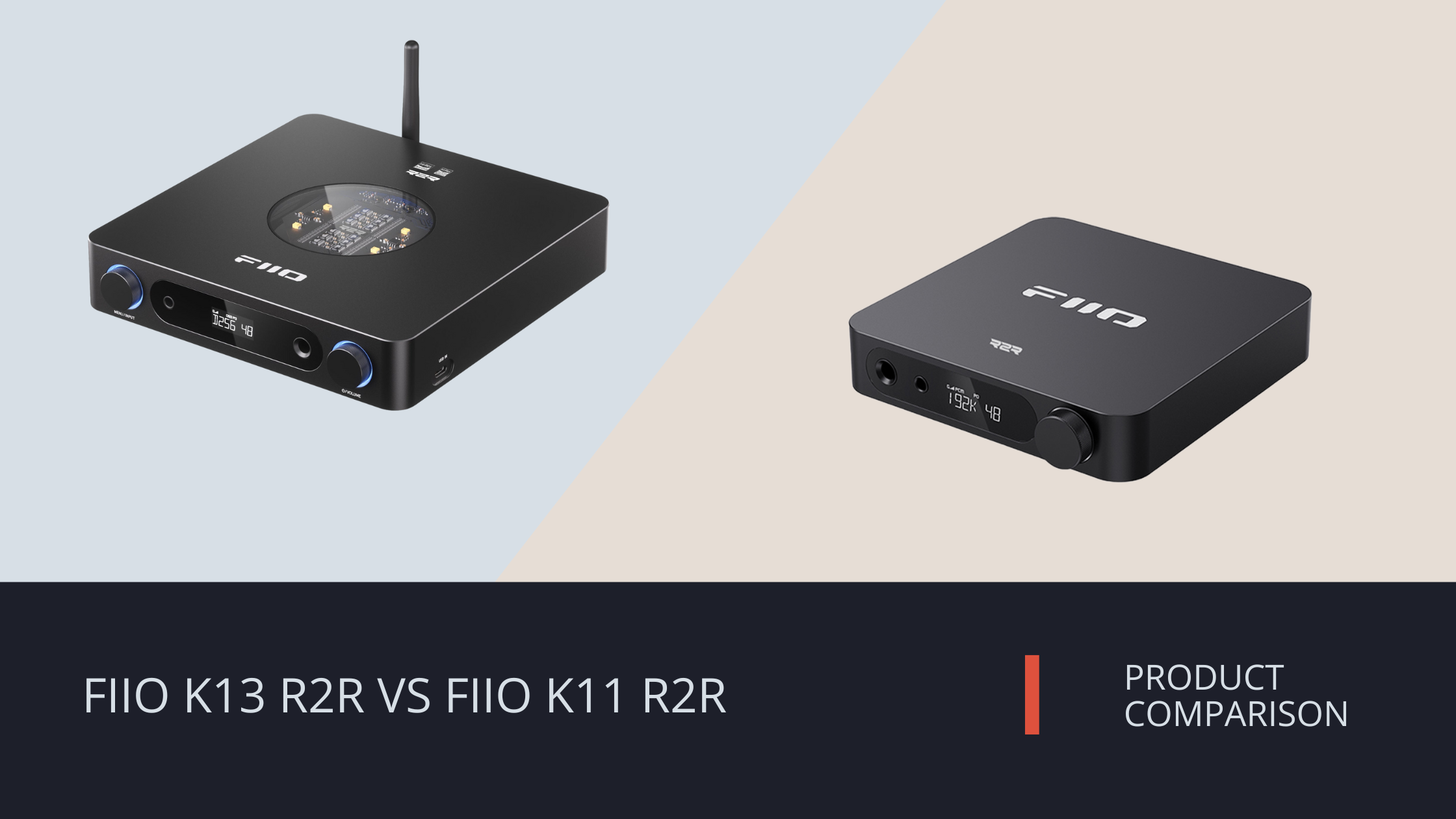
FiiO K13 R2R vs FiiO K11 R2R
How two desktop R2R DAC/amps differ in design, output power, and system role
In this post, we’ll walk through how the FiiO K13 R2R and FiiO K11 R2R differ in architecture, measurable output, connectivity, and real-world usability—and where each unit makes the most sense in a modern desktop system.
Overview
The FiiO K13 R2R is the more advanced of the two units, built around a fully differential 24-bit ladder-DAC array, a multi-rail power supply, balanced headphone output, XLR line out, and desktop-class output power. It supports USB-C, coaxial and optical, LDAC-capable Bluetooth, and includes a remote with preamp functionality and a 10-band PEQ.
The FiiO K11 R2R is a compact, entry-level desktop R2R DAC/amp designed for straightforward headphone use. It offers the same ladder-DAC concept but with simplified power delivery, fewer inputs, no Bluetooth, and lower output power. It fits smaller desks and prioritizes value and ease of use.
In rough terms:
- The K13 R2R is a fully equipped desktop hub with balanced architecture, higher power, and broader system integration.
- The K11 R2R delivers an affordable entry into R2R decoding with compact size and essential connectivity at a lower cost.
Architecture & Conversion Approach
K13 R2R — Fully differential 24-bit resistor-ladder DAC
The K13 uses a four-channel, fully balanced R2R ladder with 192 precision resistors arranged in a differential topology. Its DAC path, LPF stage, volume control, and amplifier section all operate in balanced mode. The multi-rail power supply and AC/DC dual-input design help reduce the noise floor and maintain stability under load.
This architecture supports both NOS and oversampling modes, providing flexibility for users who prefer either raw ladder conversion or interpolated playback.
K11 R2R — Compact R2R ladder DAC design
The K11 implements a simpler 24-bit resistor-ladder topology aimed at budget-oriented desktop rigs. Its power delivery, output stage, and volume control are less complex, and the signal path is not fully differential. The result is a smaller unit with reduced cost while still retaining the R2R tonal character many listeners prefer.
Compared directly, the K13’s differential layout, stronger supply regulation, and balanced signal path offer measurable advantages in noise performance, power consistency, and system integration potential.
Features & Connectivity Comparison
| Feature | K13 R2R | K11 R2R |
|---|---|---|
| DAC architecture | Fully differential 24-bit R2R ladder | 24-bit R2R ladder |
| Headphone outputs | 4.4mm balanced + 6.35mm SE | 4.4mm balanced + 6.35mm SE |
| Headphone power (32Ω) | 2,400 mW + 2,400 mW (bal) | 1,300 mW + 1,300 mW (bal) |
| Line outputs | XLR + RCA (fixed/variable) | RCA |
| Inputs | USB-C (×2), optical, coaxial | USB-C, optical |
| Bluetooth | LDAC / AAC / SBC | None |
| PEQ | 10-band parametric | None |
| NOS/OS | Yes | No |
| Preamp mode | Yes (variable XLR/RCA) | Yes (RCA only) |
| Remote control | Yes | No |
| Display | OLED | OLED |
| Power supply | AC mains + DC input (dual-supply) | USB-powered + internal supply |
| Dimensions | Larger desktop chassis | Compact footprint |
Performance Comparisons & Trade-offs
Output power and load handling
The K13’s balanced output delivers up to 2.4 W per channel into 32Ω, giving it significantly more headroom for planars and high-impedance headphones. Its SE output also exceeds the K11’s total power.
The K11 remains capable—1.3 W into 32Ω is enough for most dynamic headphones—but it has less margin for insensitive planars or high-impedance loads.
Noise floor and gain behavior
With a fully balanced signal path and multi-stage regulation, the K13 maintains a lower noise floor, especially in balanced mode. It’s more suitable for resolving headphones or sensitive active monitors.
The K11 performs well for its size but cannot match the K13’s supply stability during high-current output or long listening sessions at elevated gain.
System integration flexibility
The K13’s XLR outputs, preamp functionality, Bluetooth input, and PEQ make it more versatile as a desktop audio hub—capable of driving monitors, power amps, and headphones from one device.
The K11 is optimized for headphone-only setups and simple desktop chains.
Control and usability
The K13 includes a remote, input switching, PEQ configuration, NOS/OS options, and variable XLR/RCA output—tools aimed at more complex systems.
The K11 emphasizes simplicity: plug in, select gain, and listen.
Flexibility vs Specialization
- K13 R2R: Best suited for listeners who want a balanced ladder-DAC with high output power, preamp functionality, Bluetooth, and full system integration.
- K11 R2R: Ideal for users who want an affordable R2R DAC/amp for straightforward headphone listening without the need for XLR outputs or wireless input.
Where Each Makes Most Sense
- If you want a desktop hub with balanced outputs: Choose the K13 R2R.
- If you only need a compact headphone DAC/amp: The K11 R2R offers a simpler, more affordable solution.
- If you use demanding planars: The K13’s 2.4 W output gives much safer headroom.
- If your system is single-ended and space-limited: The K11 fits easily and avoids unused features.
- If you value EQ control and NOS/OS: Only the K13 provides both.
- If budget is the priority: The K11 provides R2R conversion at a meaningfully lower price.
Product Highlights
FiiO K13 R2R
- Fully differential 24-bit R2R ladder architecture
- 2,400 mW ×2 (32Ω, balanced)
- XLR and RCA line-outs (fixed/variable)
- Dual USB-C, optical, coaxial
- Bluetooth LDAC / AAC / SBC
- 10-band PEQ + NOS/OS switching
- AC + DC dual-supply system
- Remote control included
FiiO K11 R2R
- 24-bit R2R ladder architecture
- 1,300 mW ×2 (32Ω, balanced)
- RCA line-out
- USB-C, optical, coaxial
- Compact desktop footprint
- OLED display with gain modes