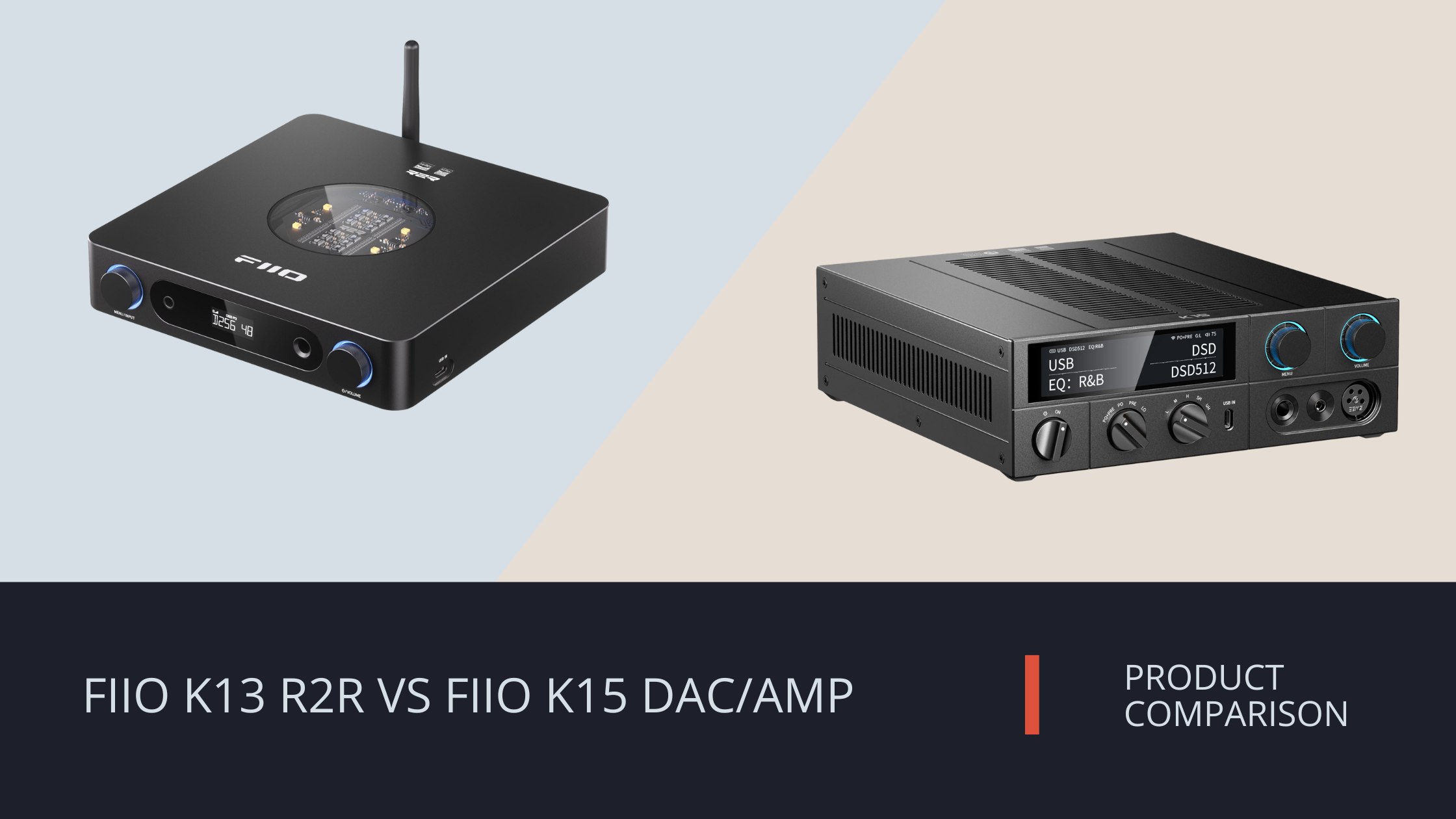
FiiO K13 R2R vs FiiO K15
How two FiiO desktop DAC/amps differ in architecture, output power, and system flexibility
In this post, we’ll walk through how the FiiO K13 R2R Desktop DAC/Amp and the FiiO K15 Desktop DAC/Amp differ in conversion design, output behavior, system features, and intended use cases—and where each device fits best in a desktop or headphone-first setup.
Overview
The FiiO K13 R2R is one of the most affordable fully differential R2R desktop units available today, built around a 24-bit resistor ladder with discrete switching. It delivers up to 2,400 mW per channel from its balanced output, adds PEQ, supports NOS/OS modes, and includes both XLR and RCA line outputs. With Bluetooth LDAC, dual USB-C inputs, and a full preamp mode, it functions as both a primary DAC and a headphone amp for a mixed desktop system.
The FiiO K15 uses dual AK4497S DAC chips and a fully balanced Class-AB headphone amplifier built around discrete ON Semiconductor MJE243G/253G transistors. With 3000 mW per channel on tap, a built-in low-noise AC power supply, Wi-Fi/Ethernet streaming, LDAC Bluetooth, AirPlay, local file playback, and a touchscreen interface, it functions as a complete desktop audio hub. The K15 supports 10-band PEQ across all digital inputs and offers both balanced and unbalanced line outputs, giving it a broader system role and higher performance tier than the K13.
In rough terms:
- K13 R2R prioritizes discrete conversion, strong, balanced output, and system flexibility at a competitive price.
- K15 delivers a more traditional delta-sigma design with smoother UI, quieter operation, and a focus on consistency over feature density.
Architecture & Conversion Approach
K13 R2R — Fully differential 24-bit resistor ladder
The K13 uses a discrete R2R ladder with matched resistors and synchronized switching to achieve linear 24-bit decoding without delta-sigma noise shaping. Its NOS/OS modes allow listeners to choose between raw R2R timing and oversampled filtering. The ladder architecture gives the K13 a slightly different transient character and a more analog-leaning output profile.
In practice, this means low distortion, stable dynamics, and a conversion approach that appeals to listeners who prefer discrete decoding over chip-based modulation.
K15 — Dual AK4497S delta-sigma platform
The K15 is built around two AK4497S DAC chips from AKM’s newest VELVET SOUND generation, operating in a fully differential topology that extends from digital conversion to the final headphone output stage. Dual Accusilicon femtosecond clocks minimize phase noise and jitter, while physically isolated digital, analog, and power sections reduce interference. This design offers a clean, highly stable noise floor, wide dynamic range, and predictable output behavior across all headphone types.
Both devices deliver clean, controlled decoding—but the K13 introduces R2R characteristics that some listeners seek out specifically for their timing and texture.
Output Power, Gain Behavior & Headphone Drive
K13 R2R — 2,400 mW balanced
The K13’s balanced output delivers 2,400 mW per channel at 32Ω, providing a strong match for planars and inefficient dynamics. The single-ended output (6.35mm) shares the same amplification stage with reduced power.
With PEQ and NOS/OS modes, the K13 gives listeners more control over system tuning, especially for brighter or leaner headphones.
K15 — 3000 mW balanced, discrete Class-AB
The K15’s discrete OP + transistor amplifier delivers over 3000 mW per channel from its balanced outputs, giving it more headroom than the K13 for demanding planars and high-impedance dynamics. Despite the higher power, its noise floor remains low enough for IEMs thanks to its balanced topology and isolated analog stage. For users who want high output levels paired with delta-sigma smoothness and excellent control, the K15 offers a significant increase in drive capability.
Connectivity & System Integration
K13 R2R — Broader I/O and Bluetooth
The K13 includes:
- Dual USB-C inputs
- Coaxial and optical inputs
- Balanced XLR and RCA line outputs
- Bluetooth LDAC / AAC / SBC
- Preamp mode with variable XLR/RCA
This range of connections allows the K13 to serve as a hub for multiple digital sources—PC, console, phone, streamer—while driving both headphones and powered monitors.
K15 — Streaming, Bluetooth, local playback, and balanced line outputs
The K15 supports a wide range of digital and analog sources:
- USB DAC (USB-C)
- Wi-Fi and Gigabit Ethernet streaming
- Roon Ready
- LDAC Bluetooth reception and AirPlay
- Local playback via USB flash storage
- Coaxial and optical digital inputs
- Balanced and unbalanced line inputs
- Balanced (XLR) and RCA line outputs
Because it can operate as a streamer, DAC, headphone amp, or preamp, the K15 occupies multiple roles in a desktop system and works cleanly with both modern and legacy gear.
Control, UI & Functional Differences
K13 R2R
- OLED display
- PEQ with 10 adjustable parameters
- NOS/OS switching
- Full preamp mode
- Remote control
These features make it adaptable to multi-device rigs and mixed speaker/headphone setups.
K15
- Touchscreen interface
- 10-band PEQ across all digital inputs
- Web-based control and OTA firmware updates
- Streaming and local playback modes
- Balanced preamp operation (XLR/RCA)
- Remote and multifunction knob
Its broader feature set and more advanced UI make it suited for users who want an all-in-one control center rather than a simpler DAC/amp.
Feature & Connectivity Comparison
| Feature | FiiO K13 R2R | FiiO K15 |
|---|---|---|
| DAC architecture | Fully differential 24-bit R2R ladder | Dual AK4497S delta-sigma (VELVET SOUND) |
| Headphone power (balanced) | 2,400 mW + 2,400 mW (32Ω) | 3,000 mW + 3,000 mW (balanced discrete Class-AB) |
| Headphone outputs | 4.4mm balanced + 6.35mm SE | 4.4mm balanced + XLR4 + 6.35mm SE |
| Line outputs | XLR + RCA (variable/fixed) | XLR + RCA, balanced preamp |
| Inputs | Dual USB-C, optical, coaxial | USB-C, optical, coaxial, Wi-Fi/Ethernet streaming, LDAC Bluetooth, AirPlay, USB flash storage, balanced/unbalanced line inputs |
| Bluetooth | LDAC / AAC / SBC | LDAC + AirPlay |
| PEQ | 10-band PEQ (digital inputs) | 10-band PEQ across all digital inputs |
| NOS/OS | Yes | No |
| Preamp mode | Yes (XLR/RCA) | Yes (balanced/unbalanced) |
| Remote | Yes | Yes |
| Power supply | External DC input | Built-in low-noise AC supply + DC input option |
| Chassis | Compact desktop chassis | Larger, streaming-enabled desktop chassis with isolated board sections |
Where Each Makes Most Sense
Choose the K13 R2R if:
- You want an affordable R2R DAC/amp with discrete decoding.
- You need a balanced XLR line out for powered monitors.
- You want PEQ, NOS/OS, and Bluetooth LDAC in one desktop unit.
- You drive planars or inefficient dynamics that benefit from 2,400 mW balanced power.
Choose the K15 if:
- You prefer the consistency of delta-sigma conversion.
- You use sensitive headphones that benefit from a lower noise floor.
- You want a simpler, quieter layout with fewer digital subsystems.
- You don’t need Bluetooth, PEQ, or advanced tuning features.
Product Highlights
FiiO K13 R2R
- Fully differential 24-bit R2R ladder
- 2,400 mW + 2,400 mW balanced output
- XLR + RCA line outputs
- Bluetooth LDAC / AAC / SBC
- 10-band parametric EQ
- NOS/OS selectable modes
- Dual USB-C inputs
- Preamp mode with variable XLR/RCA
- Remote control
FiiO K15
- Delta-sigma DAC architecture
- Low-noise output stage
- USB-C, optical, coaxial inputs
- RCA line output
- 4.4mm balanced + 6.35mm SE headphone outputs
- Remote control
Specs
FiiO K13 R2R
- DAC: 24-bit R2R ladder
- Output power: 2,400 mW + 2,400 mW (32Ω, balanced)
- Outputs: 4.4mm, 6.35mm, XLR, RCA
- Inputs: USB-C ×2, optical, coaxial
- Bluetooth: LDAC / AAC / SBC
- Modes: NOS/OS, PEQ, preamp
- Display: OLED
FiiO K15
- DAC: Delta-sigma
- Outputs: 4.4mm, 6.35mm, RCA
- Inputs: USB-C, optical, coaxial
- Modes: Filter select, preamp (RCA)
- Display: OLED