FiiO K13 R2R vs TOPPING DX5 II
Updated June 23rd, 2026
How two compact desktop DAC/amps differ in design, conversion architecture, and system use
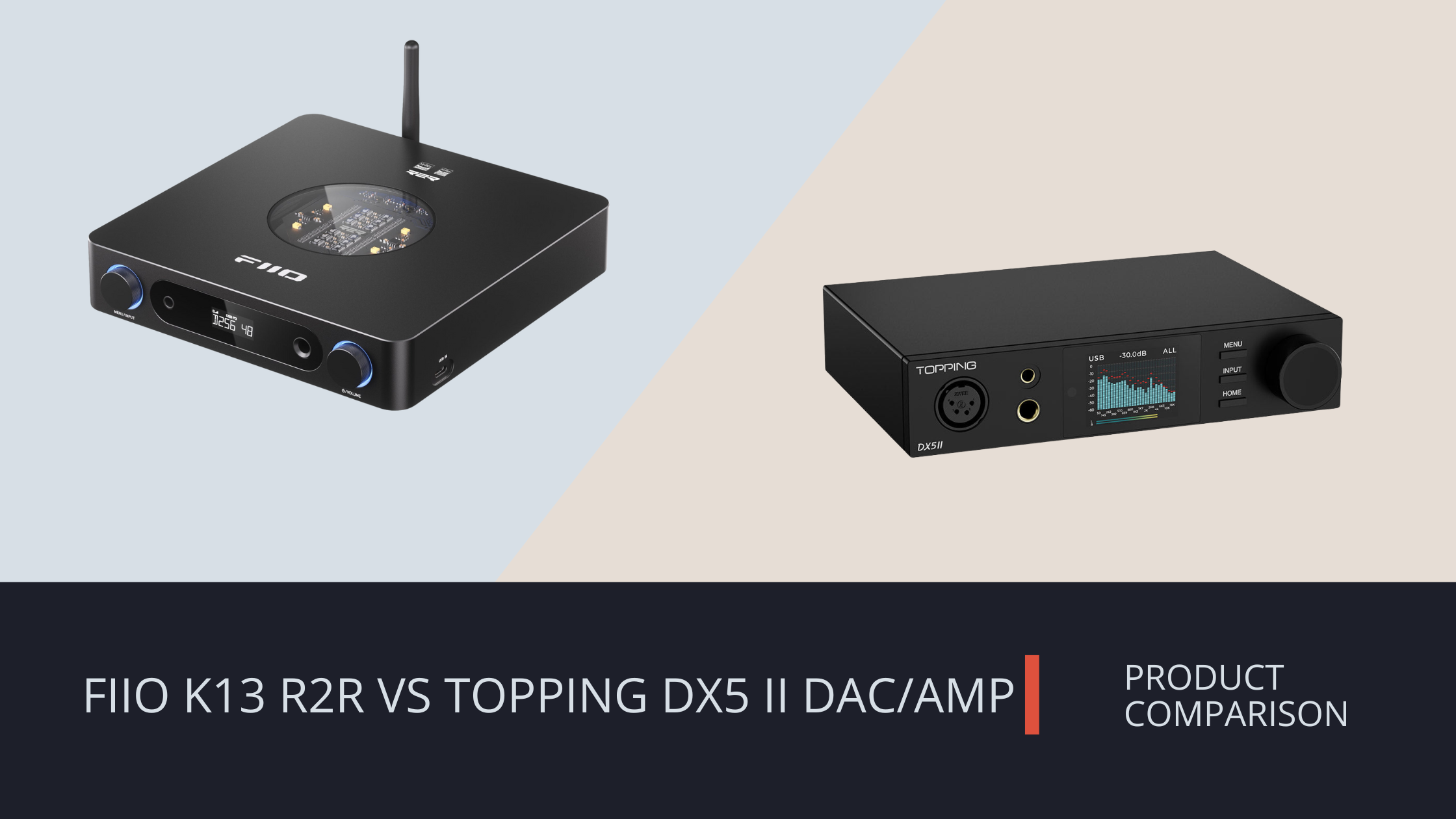
In this post, we’ll walk through how the FiiO K13 R2R and TOPPING DX5 II approach signal conversion, output behavior, and day-to-day usability—and where each might fit best in a desktop system.
Overview
The FiiO K13 R2R is a balanced desktop DAC/amp built around a fully differential 24-bit resistor-ladder design. It targets listeners who prefer the timbre and linearity of R2R architectures in a compact chassis. With a USB-C audio input, a second USB-C for power, 10-band PEQ, a NOS/OS switch, and a variable XLR/RCA stage, it functions as both a DAC/amp and a small desktop preamp.
The TOPPING DX5 II takes a different approach. It uses dual ESS ES9069Q DAC chips in a symmetrical balanced layout, supported by TOPPING’s low-noise NFCA headphone amplifier and high-resolution Bluetooth input. Designed for transparent delta-sigma decoding, it offers stable, low-distortion performance with a strong feature set in a single, small form factor.
In rough terms:
- K13 R2R focuses on discrete conversion, flexible tuning, and preamp versatility.
- DX5 II prioritizes low noise, precision, and ESS-based balance at a competitive price.
Architecture & Conversion Approach
K13 R2R — Fully differential 24-bit resistor ladder
The K13 uses a discrete resistor-ladder array to perform 24-bit digital-to-analog conversion. Each channel uses matched resistors to achieve linear output without delta-sigma modulation or high-frequency noise shaping. R2R designs like this emphasize tonal stability and natural microdynamics, especially at low levels, where quantization behavior is more dependent on physical resistor accuracy.
The K13 provides both NOS and OS modes. NOS preserves the raw sample timing, while OS applies oversampling for a smoother high-frequency response. A 10-band PEQ adds further control for headphone matching.
DX5 II — Dual ESS ES9069Q delta-sigma DACs
The DX5 II employs two ES9069Q DAC chips in a dual-mono configuration. ESS’s latest architecture improves noise shaping and clock handling, reducing jitter and distortion across the audible band. The result is high dynamic range, low-level detail retrieval, and consistent linearity—traits typical of modern ESS implementations.
TOPPING’s NFCA amp stage completes the signal path. It delivers high output power with a low noise floor, making it suitable for both sensitive IEMs and high-impedance headphones.
Both units provide balanced conversion paths, but the K13’s behavior will depend more on its resistor matching and mode selection, while the DX5 II leans on ESS’s well-established measurements and uniformity.
Features & Connectivity Comparison
| Feature | FiiO K13 R2R | TOPPING DX5 II |
|---|---|---|
| DAC architecture | Fully differential 24-bit R2R ladder | Dual ESS ES9069Q |
| Headphone outputs | 4.4mm balanced, 6.35mm SE | 4.4mm balanced, 6.35mm SE |
| Line outputs | Balanced XLR + RCA (variable/fixed) | Balanced XLR + RCA |
| Inputs | USB-C, optical, coaxial | USB, optical, coaxial, Bluetooth |
| Bluetooth | LDAC / AAC / SBC | LDAC / aptX Adaptive |
| EQ | 10-band PEQ | 10-band PEQ |
| NOS/OS | Yes | No |
| Preamp mode | Yes (variable XLR/RCA) | Yes |
| Output power | ~2.4 W + 2.4 W @ 32Ω (bal) | High-gain NFCA output for demanding headphones |
| Chassis | Full desktop chassis | Compact aluminum chassis |
Performance, Noise Floor & Output Behavior
Noise floor and dynamic response
R2R designs like the K13 tend to show slightly higher measured noise and distortion than delta-sigma units, but they maintain consistent linearity at low output levels. The DX5 II, by contrast, provides lower distortion and a lower noise floor due to its ESS chips and NFCA amp stage.
For sensitive IEMs, the DX5 II will generally run quieter. For full-size headphones, both provide ample headroom.
Output configuration and gain
The K13’s ~2.4 W balanced output gives it strong drive capability for orthodynamic headphones. The DX5 II’s NFCA stage offers comparable power with additional current stability under reactive loads.
The K13’s variable XLR/RCA mode lets it serve as a desktop preamp for powered monitors. The DX5 II can do the same, but with fewer tuning controls and no PEQ.
Control and ergonomics
Both units use bright front displays, knob-based menu control, aluminum remotes, and a 10-band PEQ.
Flexibility vs Specialization
K13 R2R
Best for listeners who want:
- discrete resistor-ladder conversion
- NOS/OS control
- PEQ tuning
- a compact balanced DAC/amp that can also act as a preamp
Its design leans toward tonal shaping and system matching.
DX5 II
Best for listeners who want:
- ESS-based transparency
- a quiet NFCA amp stage
- Bluetooth LDAC + aptX Adaptive
- consistent, low-distortion output across all loads
It excels as a clean, reference-style desktop DAC/amp with broad compatibility.
Where Each Makes the Most Sense
- If you value R2R timbre and discrete conversion: choose the K13 R2R.
- If you need the lowest noise floor and ESS stability: choose the DX5 II.
- If your system needs EQ, NOS/OS, or tuning flexibility: the K13 offers more control.
- If you rely on wireless inputs: the DX5 II provides a broader Bluetooth codec suite.
- If your priority is price-to-performance: the DX5 II typically lands lower while offering high-end measurements.
Product Highlights
FiiO K13 R2R
- Fully differential 24-bit R2R ladder DAC
- 4.4mm balanced + 6.35mm headphone outputs
- 2.4 W ×2 @ 32Ω balanced
- NOS/OS modes
- 10-band PEQ
- XLR + RCA line outputs (variable/fixed)
TOPPING DX5 II
- Dual ESS ES9069Q DAC chips
- NFCA headphone amplifier
- Balanced 4.4mm + 6.35mm outputs
- Bluetooth LDAC / aptX Adaptive
- XLR + RCA line outputs
- ESS digital filters
- 10-band PEQ
- USB, optical, and coaxial inputs
Specs
FiiO K13 R2R
- DAC architecture: 24-bit fully differential R2R
- Output power: ~2.4 W + 2.4 W @ 32Ω (balanced)
- Outputs: 4.4mm, 6.35mm, XLR, RCA
- Inputs: USB-C ×2, optical, coaxial
- EQ: 10-band PEQ
- Modes: NOS / OS
- Bluetooth: LDAC / AAC / SBC
TOPPING DX5 II
- DAC architecture: ESS ES9069Q ×2
- Output power: NFCA architecture (balanced and SE)
- Outputs: 4.4mm, 6.35mm, XLR, RCA
- Inputs: USB, optical, coaxial
- Bluetooth: LDAC / aptX Adaptive
- Digital filters: ESS presets